Same Atoms, Opposite Worlds: Why the Softest Thing in Your Pencil Is the Hardest Substance on Earth
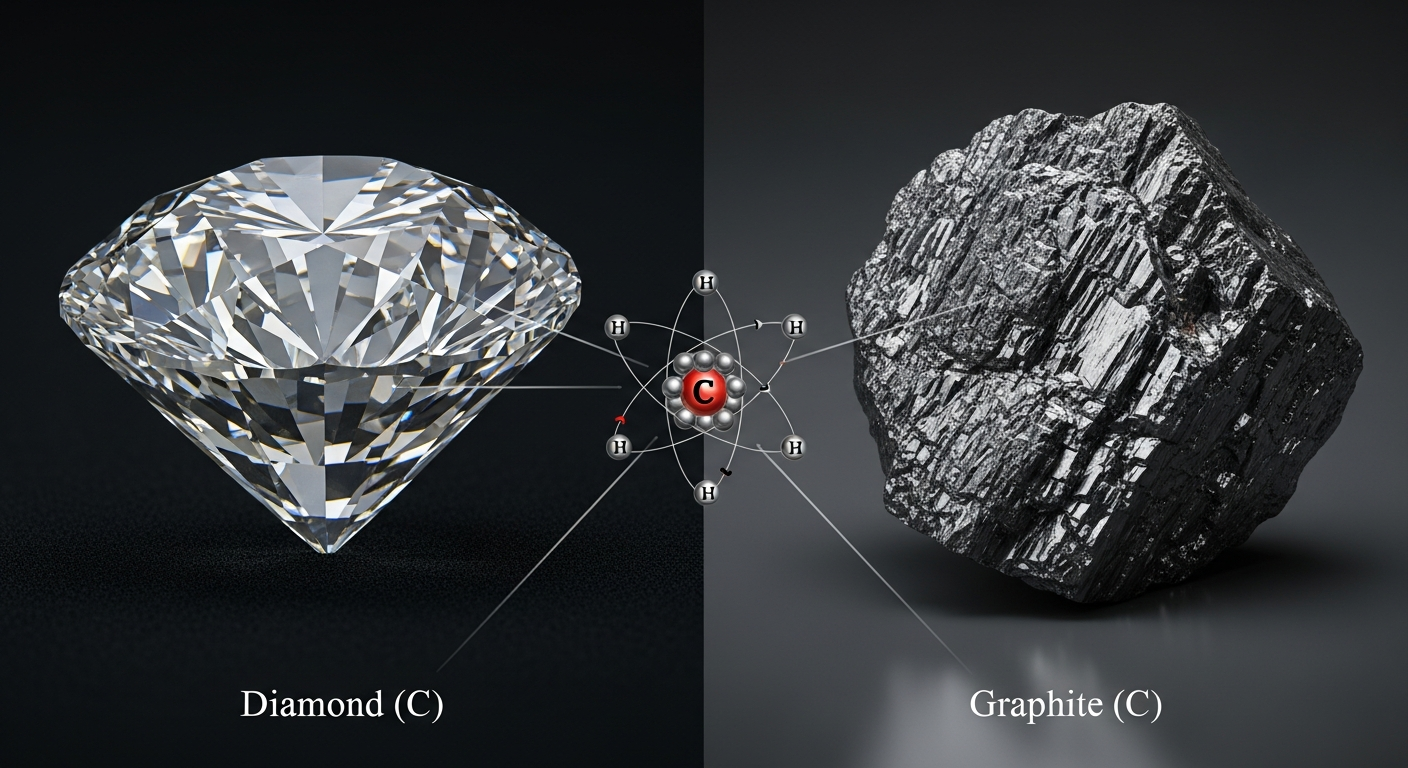 Carbon can be soft or hardest, depending on structure.
Same atoms, different worlds
By Peter Teoh, Science Writer
Challenge to the reader: A diamond’s carbon atoms sit at the corners of tetrahedra. Show — using the dot product of the vectors $(1,1,1)$ and $(1,-1,-1)$ — that the bond angle is $\cos^{-1}(-1/3) \approx 109.5^{\circ}$. Then explain how the same six protons and six electrons can produce both the hardest natural substance on Earth and the soft gray stuff in your pencil.
Diamonds and graphite are both 100% carbon. One is the hardest natural material known, a transparent insulator that scratches everything; the other is so soft it rubs off on paper and so conductive it is used in batteries. Every difference between them comes down to a single word: structure. Chemistry is not only about what atoms you have — it is about how you arrange them.
1. The core idea: structure beats composition
The same element existing in different structural forms is called allotropy, and carbon is its champion. The key is hybridization — the way carbon’s four outer electrons reshuffle into orbitals that point in different directions:
- In diamond, each carbon bonds to four neighbors in a three-dimensional network — $sp^3$ hybridization.
- In graphite, each carbon bonds to only three neighbors in flat hexagonal sheets — $sp^2$ hybridization — leaving one electron per atom free to roam between the layers.
Two geometries, two completely different materials, one element. Everything else in this post is the unfolding of that single fact.
2. Diamond: a three-dimensional cage
In diamond, every carbon atom sits at the center of a tetrahedron, bonded to four neighbors by strong covalent bonds — all of them equal in every direction, extending without interruption through the entire crystal. A diamond is, in effect, one single molecule: a giant cage of covalent bonds with no weak points.
The consequences follow directly:
- Hardness — to scratch a diamond you must break covalent bonds in three dimensions at once. Nothing natural does it better.
- Transparency — the electrons are locked up in bonds; there are no free electrons to absorb visible light. Light passes straight through.
- Insulation — with no free electrons, diamond does not conduct electricity. It is, in fact, an excellent electrical insulator with a band gap of about $5.5\ \mathrm{eV}$ — and paradoxically, one of the best heat conductors known, because its stiff lattice transmits vibrations extremely well.
- High density — the compact tetrahedral packing gives $3.52\ \mathrm{g/cm^3}$.
3. Graphite: stacked sheets with a secret gap
In graphite, each carbon bonds to only three neighbors, in flat hexagons — the same honeycomb pattern as chicken wire. The sheets stack in layers, and here is the secret: the bonds within a sheet are even stronger than diamond’s, but the forces between sheets are almost nothing.
The fourth electron of each carbon does not participate in the sheet bonds. It delocalizes into a cloud that hovers above and below the sheet — a sea of mobile electrons shared by the whole layer. The layers are held together only by weak van der Waals forces, sitting a full $335\ \mathrm{pm}$ apart — more than twice the in-plane bond length.
This one asymmetry produces all of graphite’s personality:
- Softness — the layers slide over each other almost without resistance. When you write with a pencil, you are peeling sheets off and smearing them onto paper.
- Conductivity — the delocalized electrons move freely within the sheets, so graphite conducts electricity parallel to the layers (while barely conducting across them).
- Lubrication — the slidable sheets make graphite an excellent dry lubricant, used in locks and machinery.
- Low density — the wide gaps between layers give just $2.26\ \mathrm{g/cm^3}$.
Challenge (mid-post): Graphite’s atoms are closer together within each sheet (bond length $142\ \mathrm{pm}$) than diamond’s ($154\ \mathrm{pm}$), yet graphite is far less dense. Explain this paradox using the interlayer spacing, and name the weak force holding the layers together.
4. The geometry: why carbon bends at 109.5°
Why a tetrahedron? Carbon’s four outer orbitals ($s + p_x + p_y + p_z$) mix into four identical $sp^3$ hybrids. Identical bonds repel each other equally, and the geometry that places four points as far apart as possible on a sphere is the tetrahedron, with bond angles of $109.47^{\circ}$.
The angle falls out of simple vector arithmetic. Four tetrahedral directions can be chosen as
\[(1,1,1),\quad (1,-1,-1),\quad (-1,1,-1),\quad (-1,-1,1).\]The angle between any two obeys
\[\cos\theta = \frac{\mathbf{v}_1 \cdot \mathbf{v}_2}{\lvert \mathbf{v}_1 \rvert\, \lvert \mathbf{v}_2 \rvert} = \frac{1 - 1 - 1}{3} = -\frac{1}{3}, \qquad \theta = \cos^{-1}\!\left(-\tfrac{1}{3}\right) \approx 109.47^{\circ}.\]For graphite’s threefold bonds, the orbitals spread in a plane, maximally separated: $120^{\circ}$ — the angle of the hexagon, the geometry of the honeycomb.
Challenge (mid-post): Verify the dot-product calculation above, then explain what changes when carbon $sp^2$-hybridizes: why do three orbitals spread to $120^{\circ}$ instead of four to $109.5^{\circ}$, and where does the leftover electron go?
5. Graphene: one sheet, world records
Peel a single layer off a graphite crystal — a feat first achieved in 2004 at Manchester with ordinary sticky tape — and you get graphene: a sheet of carbon exactly one atom thick. A single layer contains all of graphite’s in-plane strength with none of the slippage:
- Strength — about $130\ \mathrm{GPa}$, roughly 200 times steel per weight, the strongest material ever measured.
- Conductivity — electrons in graphene behave as if they have no mass, moving at about $10^{6}\ \mathrm{m/s}$ — a million meters per second — with record electron mobility. This earned the 2010 Nobel Prize in Physics for Andre Geim and Konstantin Novoselov.
- Flexibility and transparency — one atom of thickness absorbs only about 2.3% of white light, making it a candidate for transparent electrodes in touchscreens.
Graphene is the purest demonstration of the post’s thesis: a single sheet of carbon atoms, thinner than anything visible, is simultaneously the strongest, thinnest, and most conductive material known — all properties that a lump of coal does not have, despite identical atoms.
6. Turning one into the other: the pressure problem
If diamond and graphite are the same element, why doesn’t graphite spontaneously become diamond? Because thermodynamics and kinetics disagree. At ordinary pressure, graphite is the stable form — its Gibbs free energy is lower. Diamond is metastable: favored only at extreme pressure, where its denser packing wins, but it persists at the surface because the transformation requires breaking and remaking enormous numbers of bonds. “Diamonds are forever” is chemistry’s joke about kinetics.
The industrial solution is to provide both pressure and heat: at roughly $5$–$6\ \mathrm{GPa}$ — about 50,000 to 60,000 atmospheres — and $1300$–$1600^{\circ}\mathrm{C}$, graphite converts to diamond in days. Nearly all industrial diamond (for cutting, grinding, and drilling) is now synthetic; gem-quality stones are grown the same way. The same element, pushed through the right corner of its phase diagram, changes worlds.
7. Carbon at a glance
| Form | Bonding | Bond angle | Density | Hardness | Conducts? | Claim to fame |
|---|---|---|---|---|---|---|
| Diamond | $sp^3$ network | $109.5^{\circ}$ | $3.52\ \mathrm{g/cm^3}$ | hardest natural material | no (insulator) | drill bits, gemstones |
| Graphite | $sp^2$ sheets | $120^{\circ}$ | $2.26\ \mathrm{g/cm^3}$ | very soft | yes (in-plane) | pencils, lubricants, batteries |
| Graphene | $sp^2$ single sheet | $120^{\circ}$ | one atom thick | strongest measured | yes, spectacularly | future electronics |
| Fullerenes | $sp^2$ balls | mixed | molecular | n/a | tunable | buckyballs, drug carriers |
| Carbon nanotubes | $sp^2$ rolled sheet | $120^{\circ}$ | tubular | ultra-strong | yes | composite materials |
8. Deeper significance: allotropes everywhere
Carbon is not unique — it is merely the most dramatic example of a universal principle. Oxygen ($\mathrm{O_2}$) and ozone ($\mathrm{O_3}$) are the same element with very different chemistry; white phosphorus and red phosphorus differ so much that one ignites in air. Everywhere in chemistry, structure is a variable at least as powerful as composition.
This is why modern materials science is really “materials design”: researchers do not ask which element to use, but which arrangement of atoms produces the property they want. The entire lesson of diamond and graphite is that the atoms are the alphabet — and the material is the sentence.
Final challenge: (a) Compute how many carbon atoms are in a 1-carat diamond ($0.2\ \mathrm{g}$, molar mass of carbon $12\ \mathrm{g/mol}$, Avogadro’s number $6.022\times 10^{23}$). (b) Diamond is transparent and insulating; graphite is opaque and conducting. Explain both differences using only the electron arrangements of Sections 2 and 3. (c) Graphite conducts along its sheets but barely across them — estimate the anisotropy using the interlayer distance $335\ \mathrm{pm}$ versus the in-plane bond length $142\ \mathrm{pm}$, and name a modern technology that exploits this anisotropy.
References
- Novoselov, K. S. et al. (2004). “Electric Field Effect in Atomically Thin Carbon Films,” Science 306: 666–669. Graphene
- Bundy, F. P. et al. (1955). “Man-Made Diamonds,” Nature 176: 51–55. Synthetic diamond
- Allotropy. Allotropy - Wikipedia
- Carbon. Carbon - Wikipedia
- Orbital hybridisation. Orbital hybridisation - Wikipedia
Leave a comment