What Happens If You Fall into a Black Hole?
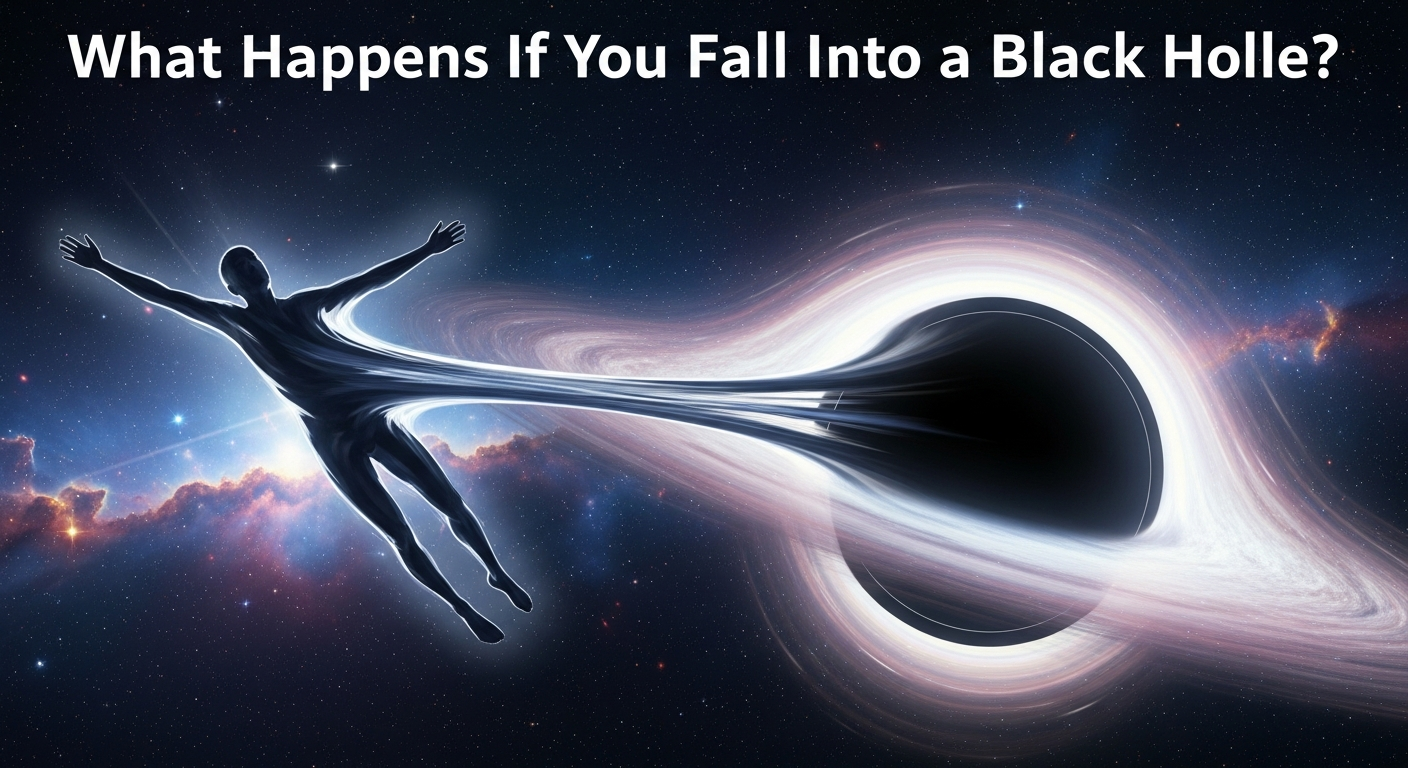 Black holes bend spacetime to extremes.
A one-way trip through warped spacetime
By Peter Teoh, Science Writer
Challenge to the reader: Estimate the radius of a black hole with the mass of the Sun, and then with the mass of the Earth, using $r_s = 2GM/c^2$ (take $G = 6.67\times 10^{-11}\ \mathrm{m^3\,kg^{-1}\,s^{-2}}$, $M_{\odot} = 2.0\times 10^{30}\ \mathrm{kg}$, $M_{\oplus} = 6.0\times 10^{24}\ \mathrm{kg}$). Then compute the tidal acceleration on a $2\ \mathrm{m}$-tall astronaut at that radius for each, using $\Delta a \approx \frac{2GM}{r_s^3}L$. Which one would “spaghettify” you, and which would let you cross the horizon intact?
A black hole is a region where gravity is so strong that not even light escapes. The closer you get, the more time and space stretch — until, at the event horizon, space and time trade places and every possible path points inward. Falling into one is the most extreme journey physics can describe, and the mathematics of general relativity tells us exactly how it would unfold.
1. The core idea: gravity is the shape of spacetime
In Newton’s picture, gravity is a force pulling masses together. In Einstein’s general relativity, gravity is curvature of spacetime. Matter tells spacetime how to curve; curved spacetime tells matter how to move. A black hole is what happens when matter is squeezed so tightly that spacetime curves into a bottomless well from which nothing — not even light — can climb out.
The geometry outside a non-rotating, uncharged black hole is described by the Schwarzschild metric (Karl Schwarzschild, 1916):
\[ds^2 = -\left(1 - \frac{r_s}{r}\right)c^2 dt^2 + \left(1 - \frac{r_s}{r}\right)^{-1} dr^2 + r^2\left(d\theta^2 + \sin^2\theta\, d\phi^2\right),\]where
\[r_s = \frac{2GM}{c^2}\]is the Schwarzschild radius — the radius of the event horizon. This single formula is the key to everything that follows.
2. The event horizon: the point of no return
You can derive $r_s$ with a classic argument. The escape velocity from a mass $M$ at distance $r$ is
\[v_{\mathrm{esc}} = \sqrt{\frac{2GM}{r}}.\]Ask: at what radius does the escape velocity equal the speed of light? Setting $v_{\mathrm{esc}} = c$ and solving for $r$ gives
\[r_s = \frac{2GM}{c^2},\]exactly the Schwarzschild radius. This Newtonian “derivation” happens to give the correct answer (the full relativistic treatment agrees), and it captures the essential physics: the horizon is where light can no longer escape.
The numbers are startling:
| Object | Mass | Schwarzschild radius $r_s$ |
|---|---|---|
| Earth | $6.0\times 10^{24}\ \mathrm{kg}$ | $\approx 9\ \mathrm{mm}$ (a marble) |
| Sun | $2.0\times 10^{30}\ \mathrm{kg}$ | $\approx 3\ \mathrm{km}$ |
| Stellar black hole | $\sim 10\,M_{\odot}$ | $\approx 30\ \mathrm{km}$ |
| Sagittarius A* (Milky Way center) | $4.3\times 10^6\,M_{\odot}$ | $\approx 1.3\times 10^7\ \mathrm{km}$ |
| M87* (imaged in 2019) | $6.5\times 10^9\,M_{\odot}$ | $\approx 2\times 10^{10}\ \mathrm{km}$ |
The entire Earth, crushed to a black hole, would be smaller than a coin. The supermassive M87* has a horizon larger than our entire Solar System out to roughly $130$ astronomical units.
3. What you would see as you fall
Suppose you — in a durable spacesuit — fall toward a black hole feet-first, while a friend watches from far away through a telescope. The two of you witness completely different versions of the same event.
From your friend’s point of view, time near the horizon runs slow. The gravitational time-dilation factor is
\[\frac{\Delta t_{\infty}}{\Delta \tau} = \frac{1}{\sqrt{1 - r_s/r}}.\]As you approach $r \to r_s$, the denominator approaches zero, so your friend sees your clock (and your motion) slow toward a complete stop. Your image also reddens and dims — the light climbing out of the gravity well loses energy, described by the gravitational redshift
\[\frac{\lambda_{\mathrm{obs}}}{\lambda_{\mathrm{emit}}} = \frac{1}{\sqrt{1 - r_s/r}}.\]As $r \to r_s$ the redshift grows without bound, so your image fades to invisible infrared and then radio, and finally vanishes. Your friend never actually sees you cross the horizon.
From your point of view, nothing special happens at the horizon. Your own proper time ticks normally, you cross the boundary in a finite time, and for a large black hole you might not even notice the crossing. The horizon is not a physical surface — it is a mathematical boundary, a “point of no return” in the geometry of spacetime.
Challenge (mid-post): The gravitational redshift formula predicts infinite redshift at $r = r_s$. Compute $\lambda_{\mathrm{obs}} / \lambda_{\mathrm{emit}}$ when you are at $r = 2\,r_s$ (twice the horizon radius). What does the $\sqrt{}$-factor become, and by what factor has your light been reddened there?
4. Spaghettification: why tides are lethal
The most dramatic effect — and the one that gives black holes their horror-movie reputation — is spaghettification. It comes not from the total gravity, but from the difference in gravity across your body.
Gravity falls off with distance. If your feet are a distance $L$ closer to the black hole than your head, your feet feel slightly stronger gravity than your head. The difference — the tidal acceleration — is
\[\Delta a \approx \frac{2GM}{r^3}\, L.\]This is just the rate at which Newtonian gravity $GM/r^2$ changes with distance, multiplied by your length $L$. At the event horizon ($r = r_s = 2GM/c^2$), this becomes
\[\Delta a_{\text{horizon}} \approx \frac{2GM}{r_s^3}L = \frac{c^6}{4 G^2 M^2}\, L.\]The crucial feature is the $1/M^2$ dependence: the tidal force at the horizon gets weaker as the black hole gets bigger. This leads to a counterintuitive but famous result:
-
A stellar-mass black hole ($\sim 10\,M_{\odot}$, $r_s \approx 30\ \mathrm{km}$) has a small radius, so the tidal gradient is enormous. For a $2\ \mathrm{m}$ astronaut, $\Delta a \approx 2\times 10^7\,g$ — you would be torn apart into a stream of atoms long before reaching the horizon.
-
A supermassive black hole ($\sim 10^8\,M_{\odot}$) has a huge radius, so the tidal gradient at the horizon is utterly gentle — comparable to ordinary terrestrial gravity. You could cross the event horizon intact, and only be spaghettified much later, deep inside near the singularity, where physics as we know it breaks down.
Challenge (mid-post): Show that the tidal acceleration at the horizon scales as $M^{-2}$. Starting from $\Delta a \approx \frac{2GM}{r_s^3}L$, substitute $r_s = 2GM/c^2$ and simplify. Then explain, in one sentence, why a $10^8\,M_{\odot}$ black hole is about $10^{14}$ times gentler at its horizon than a $10\,M_{\odot}$ black hole.
5. Inside the horizon: space and time swap roles
The Schwarzschild metric of Section 1 holds a deep secret. Look at the signs of the $dt^2$ and $dr^2$ terms:
\[ds^2 = -\left(1 - \frac{r_s}{r}\right)c^2 dt^2 + \left(1 - \frac{r_s}{r}\right)^{-1} dr^2 + \cdots\]Outside the horizon ($r \gt r_s$), the factor $\left(1 - r_s/r\right)$ is positive, so the time term is negative and the radial term is positive — time behaves like time, space behaves like space.
Inside the horizon ($r \lt r_s$), the factor flips sign. The $dt^2$ term becomes positive and the $dr^2$ term becomes negative. Time and space swap roles. Inside the horizon, decreasing $r$ is no longer a spatial direction you can choose to avoid — it becomes as inevitable as the future. Just as you cannot help moving forward in time in ordinary life, inside a black hole you cannot help moving inward toward the singularity.
This is why “no force can hold you back.” Inside the horizon, every path — even a path pointing “outward” — still terminates at the singularity at $r = 0$, where the curvature becomes infinite and general relativity predicts its own breakdown.
6. How long until it’s over?
A common misconception is that falling into a black hole takes forever. From the faller’s point of view, it is remarkably quick.
For a freely falling observer (one who starts from rest at infinity), the proper time to go from the horizon to the singularity is finite and proportional to the black hole’s mass. The exact result for radial free-fall is
\[\tau = \frac{4}{3}\frac{G M}{c^3},\]from horizon to singularity. In terms of the Schwarzschild radius, this is $\tau = \frac{2}{3} r_s / c$:
- A $10\,M_{\odot}$ black hole: $\tau \sim 10^{-4}\ \mathrm{s}$ — under a tenth of a millisecond from horizon to doom.
- A $10^8\,M_{\odot}$ supermassive black hole: $\tau \sim 10^3\ \mathrm{s}$ — about 11 minutes of falling before the singularity.
So for a supermassive black hole, after crossing the horizon you would have a little over ten minutes (by your own clock) to contemplate your fate before the tidal forces grew strong enough to finish the job.
7. Beyond the ideal case: rotating black holes and real observations
The Schwarzschild metric describes a non-rotating, uncharged black hole. Real black holes rotate, and are described by the Kerr metric. Rotation drags spacetime around the hole (an effect called frame dragging), and it shrinks the innermost stable orbit. But the qualitative story — horizon, no return, spaghettification scaling as $M^{-2}$ — survives.
Black holes are not just theory. In 2019 the Event Horizon Telescope collaboration released the first image of a black hole’s shadow — the glowing ring of superheated gas around the dark silhouette of M87. In 2015, LIGO detected gravitational waves from two stellar-mass black holes spiraling together and merging, matching the predictions of general relativity to extraordinary precision. And the GRAVITY instrument has tracked stars orbiting Sagittarius A, the black hole at the center of our own galaxy.
Challenge (mid-post): The event horizon of M87* is about $2\times 10^{10}\ \mathrm{km}$. Light crosses this distance in about $2\times 10^{10}/3\times 10^5 \approx 6.7\times 10^4$ seconds. Convert that to hours, and note that this is roughly how long it would take light to travel from one side of the black hole to the other — a sense of the object’s true, unimaginable scale.
8. Deeper significance: the information paradox
Black holes sit at the crossroads of the two great pillars of modern physics — general relativity and quantum mechanics — and the two do not yet agree.
In 1974, Stephen Hawking showed that black holes are not perfectly black: quantum effects near the horizon cause them to emit Hawking radiation and slowly evaporate. This raises the black hole information paradox: if you throw a book (or an astronaut) into a black hole, and the black hole eventually evaporates into thermal radiation, is the information in the book destroyed? Quantum mechanics insists information cannot be destroyed; general relativity seems to say it can. Resolving this tension — through ideas like holography, the AdS/CFT correspondence, and “island” proposals — is one of the deepest open problems in theoretical physics.
So the question “what happens if you fall into a black hole?” is not just a thought experiment. It touches the very foundations of what space, time, and information are.
Final challenge: (a) Compute the Schwarzschild radius of a black hole with the mass of Mount Everest (about $10^{15}\ \mathrm{kg}$) and express it in meters — is it larger or smaller than a proton ($\sim 10^{-15}\ \mathrm{m}$)? (b) Explain, using $\Delta a \approx \frac{2GM}{r_s^3}L$, why a smaller black hole is more dangerous at its horizon. (c) A distant friend watches you fall and claims you “never cross the horizon.” Reconcile their observation with the fact that your own watch records a finite, comfortable crossing time.
References
- Schwarzschild, K. (1916). “On the Gravitational Field of a Mass Point According to Einstein’s Theory.” Schwarzschild metric
- Hawking, S. W. (1974). “Black hole explosions?” Nature 248: 30. Hawking radiation
- Event Horizon Telescope Collaboration (2019). “First M87 Event Horizon Telescope Results.” The Astrophysical Journal Letters 875: L1. Black hole image
- Abbott, B. P. et al. (LIGO/Virgo) (2016). “Observation of Gravitational Waves from a Binary Black Hole Merger,” Physical Review Letters 116: 061102. Gravitational waves
- Thorne, K. S. (1994). Black Holes and Time Warps: Einstein’s Outrageous Legacy. W. W. Norton. (The physics behind the film Interstellar.)
- Black hole. Wikipedia
- Event horizon. Wikipedia
- Spaghettification. Wikipedia
- Black hole information paradox. Wikipedia
Leave a comment