Cancer’s Kryptonite: How Scientists Train Your Own Immune System to Hunt Tumors
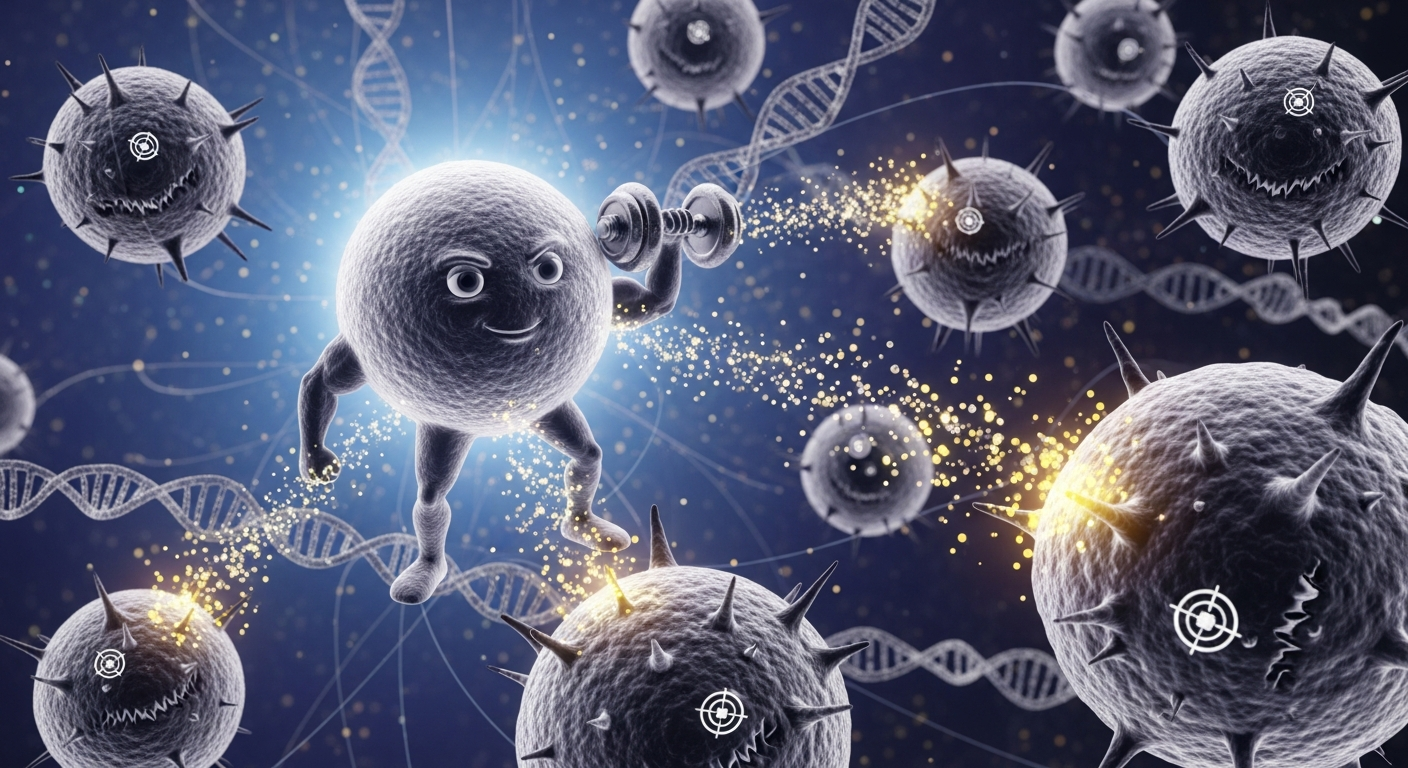 Immunotherapy trains the body to fight cancer.
Turning the immune system into a therapy
By Peter Teoh, Science Writer
Challenge to the reader: A tumor of $1\ \mathrm{cm^3}$ contains about $10^{9}$ cancer cells. If a single cancer cell divides every 60 days on average, how many doublings does it take to grow from one cell into a $1\ \mathrm{cm^3}$ tumor, and how many years does that take? Then explain why the same arithmetic makes early detection a race of only a few doublings — and why the immune system’s killer cells, doubling at their own pace, are a weapon that can win it.
For a century, cancer treatment meant attacking the tumor from the outside: cut it out, burn it with radiation, poison it with chemotherapy. Immunotherapy is the first strategy that works from the inside — teaching the body’s own immune system to recognize and destroy cancer cells. The results have been dramatic enough that “cancer vaccines,” “checkpoint inhibitors,” and “CAR-T” have moved from science fiction to standard oncology in a single generation.
1. The core idea: cancer hides; immunotherapy unhides it
Your immune system already knows how to kill cancer — it does it constantly. T cells patrol the body, checking every cell’s identity papers (protein fragments displayed on the cell surface) and destroying anything unrecognizable. The reason cancer survives is not that the immune system is blind to it, but that tumors actively suppress the immune response.
Tumors exploit the immune system’s own safety mechanisms. To prevent autoimmunity, T cells carry checkpoint proteins — brakes that stop the kill response when other cells present the right counter-signal. Tumors learn to present that counter-signal: they wave the flag that says “self, do not attack,” and the T cells stand down. Immunotherapy’s first great insight is that removing the brakes can be enough.
2. The brakes: how checkpoints let tumors hide
The best-understood checkpoint pair is PD-1 (on T cells) and PD-L1 (on other cells). When PD-L1 binds PD-1, the T cell receives a stop signal. Many tumors coat themselves in PD-L1 — some even respond to the immune system’s own attack signal, interferon-gamma, by upregulating PD-L1, tightening the brake exactly when the T cells get aggressive.
A second brake, CTLA-4, works earlier, in the lymph nodes where T cells are first activated.
The therapeutic move is beautifully direct: antibodies that block these interactions. Checkpoint inhibitors — pembrolizumab, nivolumab (anti-PD-1), atezolizumab (anti-PD-L1), ipilimumab (anti-CTLA-4) — physically plug the binding site, like jamming a keyhole, so the stop signal never arrives. The T cells, their brakes released, resume the attack. James Allison and Tasuku Honjo won the 2018 Nobel Prize in Physiology or Medicine for discovering these brakes and their blockade.
Challenge (mid-post): A tumor upregulates PD-L1 in response to interferon-gamma. Explain why this is evidence that the immune system was already attacking the tumor before the drug — and why that implies checkpoint inhibitors work best on “hot” tumors already infiltrated by T cells. What would you predict for “cold” tumors with no T cells inside?
3. Releasing the brakes: what checkpoint inhibitors achieve
The clinical impact has been historic — but uneven. In melanoma (once almost untreatable once metastatic), checkpoint blockade turned a disease with a few months’ median survival into one where a substantial fraction of patients live for years. A subset of lung, kidney, bladder, and lymphoma patients — 20–40% depending on the cancer — achieve durable, sometimes complete, responses.
The word durable is the key. Chemotherapy kills dividing cells and stops when the drug stops; a checkpoint response can persist for a decade, because the immune system remembers — the patient now has memory T cells trained on their own tumor, the biological equivalent of a lifelong vaccine. That is the second great insight of immunotherapy: treating the patient’s immune system, not the tumor, converts a one-time drug into permanent surveillance.
4. CAR-T: building a guided missile from your own cells
Checkpoint inhibitors release brakes; CAR-T builds a weapon. The procedure, in its essence:
- Harvest — T cells are collected from the patient’s blood.
- Engineer — the cells are given a new gene encoding a chimeric antigen receptor (CAR): a synthetic sensor that recognizes a protein on the cancer cell (for B-cell cancers, the target is CD19), fused to activation machinery that turns recognition into killing.
- Expand and return — the engineered cells are multiplied to billions in the lab and infused back into the patient, where they hunt cells bearing CD19 — which is to say, the cancer.
The results in blood cancers have been stunning: in acute lymphoblastic leukemia, response rates of 80–90%, including children whose disease had survived everything else. The first pediatric patient treated, Emily Whitehead, had relapsed leukemia in 2012 and remains cancer-free today.
The math of the treatment is the math of clonal expansion: T cells that recognize their target divide exponentially, each activated cell making two, then four, then eight:
\[N = N_0 \times 2^{n}.\]An infusion of $10^{9}$ engineered T cells that doubles 5 times becomes
\[10^{9} \times 2^{5} = 3.2\times 10^{10}\]killer cells — a larger army than the entire tumor, each cell capable of killing multiple targets in sequence.
Challenge (mid-post): A patient’s tumor contains $10^{11}$ cancer cells and the infused CAR-T population starts at $10^{9}$ cells. How many doublings until the T cells outnumber the tumor? If each T cell kills 5 cancer cells, how many doublings are actually required to clear the tumor — and what does this say about the race between tumor growth and immune expansion?
5. The math of a growing tumor: doubling time
Tumors grow exponentially until they outrun their blood supply. The growth law is
\[N(t) = N_0 \, 2^{\,t / T_d},\]with a typical doubling time $T_d \approx 60$ days for a clinically observed cancer. A single transformed cell reaches the $10^{9}$ cells of a $1\ \mathrm{cm^3}$ tumor in
\[n = \log_2 10^{9} \approx 30\ \text{doublings},\]or about 5 years. But most of that growth is invisible: imaging detects tumors at roughly $10^{8}$–$10^{9}$ cells, when the final 10 doublings remain. The doubling-time arithmetic explains why screening saves lives — catching a tumor 3 doublings earlier (about 6 months) is catching it when it is one-eighth the size, far easier to control — and why immunotherapy, which multiplies its own force with every encounter, is matched to the problem’s geometry.
6. The risks: when the immune system overachieves
An immune system with its brakes removed can overshoot. The signature risk of CAR-T is cytokine release syndrome (CRS) — a storm of inflammatory signals released as billions of activated T cells fight the tumor, causing fever, low blood pressure, and in severe cases organ failure. The signature risk of checkpoint blockade is autoimmunity: the immune system, released from its brakes, can attack the skin, gut, liver, or endocrine glands — the price of removing the safety mechanisms that keep self-tolerance.
These side effects are themselves a proof of concept: they happen because the treatment works. Modern management — the antibody tocilizumab to soak up one key cytokine in CRS, corticosteroids to dampen autoimmunity — has made the risks manageable, and every new design (logic-gated CARs that require two cancer markers, off-switches that kill the engineered cells on command) is an attempt to keep the storm while removing the damage.
7. Immunotherapy at a glance
| Therapy | Mechanism | Best responses | Signature risk |
|---|---|---|---|
| Checkpoint inhibitors | release T-cell brakes (PD-1/PD-L1, CTLA-4) | melanoma, lung, kidney: 20–40% | autoimmunity |
| CAR-T | engineer T cells to target CD19 | B-cell leukemias/lymphomas: 80–90% | cytokine release syndrome |
| Cancer vaccines | train T cells against tumor antigens | prostate (sipuleucel-T); in trials elsewhere | usually mild |
| Bispecific antibodies | tether T cells to cancer cells | some lymphomas and myeloma | CRS, neurotoxicity |
| Oncolytic viruses | viruses that kill tumors and alert the immune system | melanoma (T-VEC) | usually mild |
8. Deeper significance: a fourth pillar of cancer care
Surgery, radiation, and chemotherapy all attack the tumor; immunotherapy attacks the problem of cancer. Its deepest promise is that an immune system trained on a patient’s own cancer keeps the lesson for life — the memory T cells that cleared the tumor remain on patrol, which is why some immunotherapy patients stop treatment after two years and never relapse.
The frontier is personalization: sequencing each tumor to find its unique mutated proteins (neoantigens), then manufacturing a vaccine against them; combining checkpoint blockade with CAR-T so the engineered cells are not re-braked inside the tumor; and extending the approach from cancer to autoimmune disease, where the same tools, pointed the other way, can restore tolerance. The immune system, it turns out, is the most sophisticated drug-delivery and targeting system biology has ever built — and we are only beginning to learn how to program it.
Final challenge: (a) Using Section 5, compute how many cells a tumor has after 10 years of undetected growth at a 60-day doubling time, and how much earlier detection would be needed to catch it at $10^{8}$ cells. (b) A CAR-T infusion of $10^{9}$ cells doubles every 12 hours during its expansion phase. How many cells exist after 3 days, and why does this growth curve explain both the therapy’s power and CRS? (c) Explain why checkpoint inhibitors rarely help “cold” tumors — and propose, using the table, a combination strategy that could heat them up.
References
- Leach, D. R., Krummel, M. F. & Allison, J. P. (1996). “Enhancement of antitumor immunity by CTLA-4 blockade,” Science 271: 1734–1736.
- Pardoll, D. M. (2012). “The blockade of immune checkpoints in cancer immunotherapy,” Nature Reviews Cancer 12: 252–264.
- Maude, S. L. et al. (2014). “Chimeric Antigen Receptor T Cells for Sustained Remissions in Leukemia,” New England Journal of Medicine 371: 1507–1517.
- Rosenbaum, L. (2017). “Tragedy, Perseverance, and Chance — The Story of CAR-T Therapy,” New England Journal of Medicine 377: 1313.
- Cancer immunotherapy. Cancer immunotherapy - Wikipedia
- CAR T-cell therapy. CAR T-cell therapy - Wikipedia
Leave a comment