Can We Rewind the Cellular Clock? Inside the Race to Reverse Aging
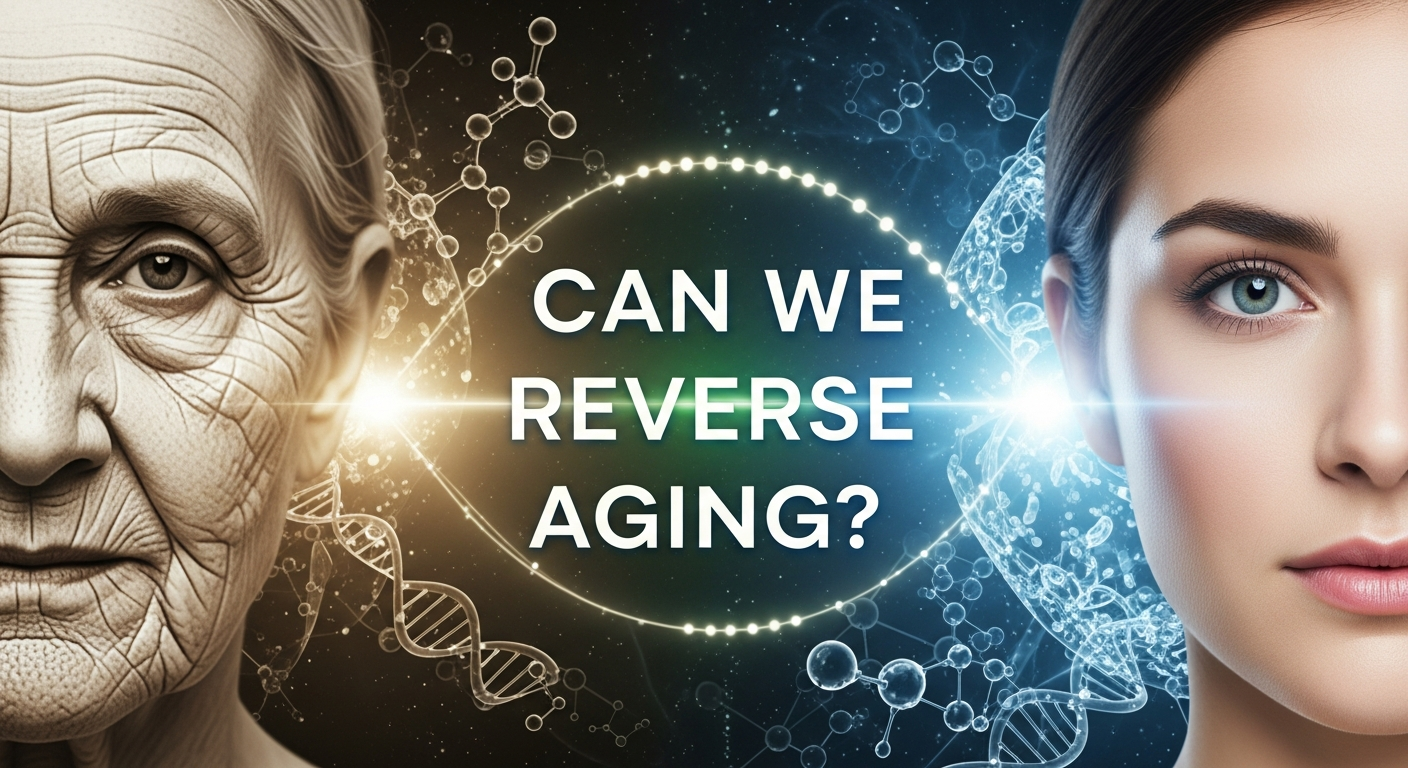 Aging research targets damage and senescence.
Slowing the cellular clock
By Peter Teoh, Science Writer
Challenge to the reader: Human mortality risk doubles roughly every 8 years after age 30 (the Gompertz law). (1) Compute how many times riskier death is for a 70-year-old than for a 30-year-old. (2) A cell’s telomeres shorten by about 100 base pairs per division, and cells stop dividing once they fall to roughly 4,000 base pairs. How many divisions remain for a cell whose telomeres currently measure 6,000 base pairs? Use both answers to explain why aging researchers talk about many clocks at once.
Aging is not one process but a network of them: DNA damage, shortening telomeres, exhausted stem cells, zombie-like senescent cells, and a drifting epigenome. Modern medicine has learned to fix acute diseases; aging is the chronic disease written into every cell. The question is no longer whether these processes can be slowed — animal experiments show they can — but whether they can be safely slowed in humans, and what “reversing aging” would even mean.
1. The core idea: aging is many clocks running at once
Researchers organize aging around the hallmarks of aging, a list of the damage types that accumulate together:
- Genomic instability — mutations and chromosome damage.
- Telomere attrition — the protective caps on chromosomes wearing down.
- Epigenetic drift — the chemical tags that control gene activity losing their settings.
- Cellular senescence — cells that stop dividing but refuse to die, leaking inflammatory signals.
- Mitochondrial dysfunction — the cell’s power plants failing.
- Stem cell exhaustion — the body’s repair crews running out.
Each hallmark is a clock of its own, ticking at its own rate, and they feed each other: DNA damage accelerates telomere loss; senescent cells poison their neighbors into senescing too. “Reversing aging” is therefore not one intervention but a campaign against a network.
2. The telomere countdown: a molecular fuse
Telomeres are the protective caps at the ends of chromosomes. Every time a cell divides, the DNA-copying machinery cannot copy the very end of each chromosome, so the telomere gets shorter. When it shrinks below a critical length, the cell enters replicative senescence — it stops dividing permanently.
Human telomeres start at about 11,000 base pairs at birth and shrink by roughly 50–200 base pairs per division — call it 100 on average. Cells hit their dividing limit at roughly 4,000 base pairs. The arithmetic gives the famous Hayflick limit — the number of divisions a normal human cell can undergo before it stops:
\[\text{divisions remaining} = \frac{\text{telomere length} - 4000}{100}.\]A newborn’s cell: $(11000 - 4000)/100 = 70$ divisions. A middle-aged cell with 6,000 base pairs has only 20 divisions left. Stem cells and cancer cells evade the fuse by expressing telomerase, an enzyme that rebuilds telomeres — cancer cells essentially become immortal by switching it on.
Challenge (mid-post): If a cell starts at 11,000 base pairs and divides every 2 days, how long until replicative senescence at 70 divisions — and why is this limit not the reason we age overall (most cells in an adult body divide rarely, if ever)? Which organ systems would you expect to feel the Hayflick limit first?
3. Zombie cells: senescence and senolytics
A senescent cell is not dead — it is retired and dangerous. It has stopped dividing (which protects against cancer) but keeps secreting inflammatory signals, collectively called the SASP (senescence-associated secretory phenotype). These signals damage neighboring tissue, promote inflammation, and even recruit nearby cells into senescence. In a young body, the immune system clears senescent cells efficiently; in an aged body, they accumulate.
The therapeutic idea follows directly: senolytics — drugs that selectively kill senescent cells, sparing healthy ones. In mice, senolytics have delayed, prevented, or alleviated a striking list of age-related conditions: cataracts, osteoporosis, cardiovascular dysfunction, and frailty, with lifespan extensions in some studies of 20–35%. The first human trials are underway for conditions like osteoarthritis and lung fibrosis. The math of the intervention is brutal and beautiful: removing a small fraction of cells that poison their neighbors can rescue the whole neighborhood.
4. The epigenetic clock: reading biological age
The newest and most accurate clock is not physical but informational. DNA methylation — small chemical tags that switch genes on and off — drifts with age in a predictable pattern. In 2013, Steve Horvath showed that a set of about 350 methylation sites can predict a person’s chronological age with a median error of just $\pm 3.6$ years across tissues — the Horvath clock.
More remarkably, the clock reads biological age, not calendar age. People whose clock runs fast have higher mortality risk; centenarians’ clocks run slow. And in mice, the clock can be turned back: in 2016, Juan Carlos Izpisúa Belmonte’s lab briefly activated the four Yamanaka factors — the genes that reprogram adult cells back to a stem-cell state — and reversed several hallmarks of aging in live mice, extending their lives without producing tumors. Partial reprogramming is now the most-discussed route toward genuine age reversal: not slowing the clock, but resetting its hands.
Challenge (mid-post): Two 50-year-olds take an epigenetic-clock test. One reads 62, the other reads 41. If mortality risk doubles every 8 years, estimate how their mortality risks compare to each other. Then explain the crucial experimental distinction: how would you tell whether an anti-aging drug slowed the clock itself versus merely repaired one downstream organ?
5. The math of mortality: Gompertz and doubling time
The deepest regularity in aging is the Gompertz–Makeham law: after early adulthood, human mortality risk rises exponentially with age. In its pure form,
\[\mu(t) = \mu_0\, e^{\gamma t},\]where $\mu(t)$ is the mortality rate at age $t$ and $\gamma \approx 0.087$ per year — corresponding to a doubling time of
\[t_{\text{double}} = \frac{\ln 2}{\gamma} \approx 8\ \text{years}.\]Forty years separate age 30 from age 70, so mortality risk grows by $2^{40/8} = 2^{5} = 32$ times. Every 8 years, your body’s cumulative failure rate doubles. This is why aging research targets the rate $\gamma$ rather than any single disease: slowing $\gamma$ by even 20% would postpone all age-related disease simultaneously — heart disease, cancer, dementia — which no single-disease therapy can do.
| Age | Mortality rate (relative) | Doublings since 30 |
|---|---|---|
| 30 | 1 | 0 |
| 38 | 2 | 1 |
| 46 | 4 | 2 |
| 54 | 8 | 3 |
| 62 | 16 | 4 |
| 70 | 32 | 5 |
6. What has actually worked in animals
The honest scoreboard, roughly in order of evidence:
- Caloric restriction — the oldest and most reproducible intervention; extends lifespan in species from yeast to primates, plausibly by slowing metabolism and growth signaling (the mTOR pathway).
- Rapamycin — the drug that inhibits mTOR directly; extends mouse lifespan even when started late in life, the strongest pharmaceutical result to date.
- Senolytics — remove zombie cells; extend healthspan, and lifespan in some mouse studies.
- Partial reprogramming — the Yamanaka factors; the only intervention that has reversed hallmarks, not just slowed them, though it also risks producing teratomas if pushed too far.
- Exercise, sleep, and food quality — the unglamorous interventions with the best human evidence, because they modulate many of the same pathways simultaneously.
The pattern across every successful intervention is striking: they all converge on a small set of ancient nutrient- and stress-sensing pathways (mTOR, IGF-1, AMPK, sirtuins). Aging may look like a thousand independent failures; at the cellular level, it is a handful of master switches.
7. Deeper significance: healthspan, not just lifespan
Suppose the science succeeds. The goal most researchers actually state is not a 200-year lifespan but healthspan — compressing the period of disease and frailty at the end of life. Slowing $\gamma$ by 25% would shift the onset of every age-related disease by roughly a decade, without any promise of immortality.
And the deeper philosophical point: aging is not a law of physics — it is a biology of trade-offs. There are organisms that do not measurably age (hydra, some jellyfish, lobsters grow indefinitely), and the difference is not mystical, it is a difference in maintenance budgets. Evolution optimizes for reproduction, not repair; once you have passed your genes on, natural selection stops caring how long the machinery lasts. The aging field’s quiet claim is that this neglect is fixable — that the body already knows how to repair itself, and merely stops bothering.
Final challenge: (a) Using the Gompertz law, compute how a 20% slower $\gamma$ changes the age at which mortality risk reaches 32 times its age-30 baseline (currently 70). (b) A senolytic trial removes senescent cells from a mouse and its healthspan extends 25%. Explain why measuring “lifespan” alone can miss the benefit, and design a 3-measure scorecard for the human trial. (c) The Yamanaka factors can reset the epigenetic clock — explain, using Sections 2 and 3, why resetting every clock at once could also cause cancer, and what “partial” reprogramming does to dodge that.
References
- López-Otín, C. et al. (2013). “The Hallmarks of Aging,” Cell 153: 1194–1217. Aging
- Hayflick, L. & Moorhead, P. (1961). “The serial cultivation of human diploid cell strains,” Experimental Cell Research 25: 585–621. Hayflick limit
- Horvath, S. (2013). “DNA methylation age of human tissues and cell types,” Genome Biology 14: R115. Epigenetic clock
- Ocampo, A. et al. (2016). “In Vivo Amelioration of Age-Associated Hallmarks by Partial Reprogramming,” Cell 167: 1719–1733.
- Xu, M. et al. (2018). “Senolytics improve physical function and increase lifespan in old age,” Nature Medicine 24: 1246–1256. Senescence
- Gompertz, B. (1825). “On the nature of the function expressive of the law of human mortality,” Philosophical Transactions of the Royal Society 115: 513. Gompertz–Makeham law
Leave a comment