The Nightly Brain Flush: Why Sleep Is the Most Powerful Drug You Never Took
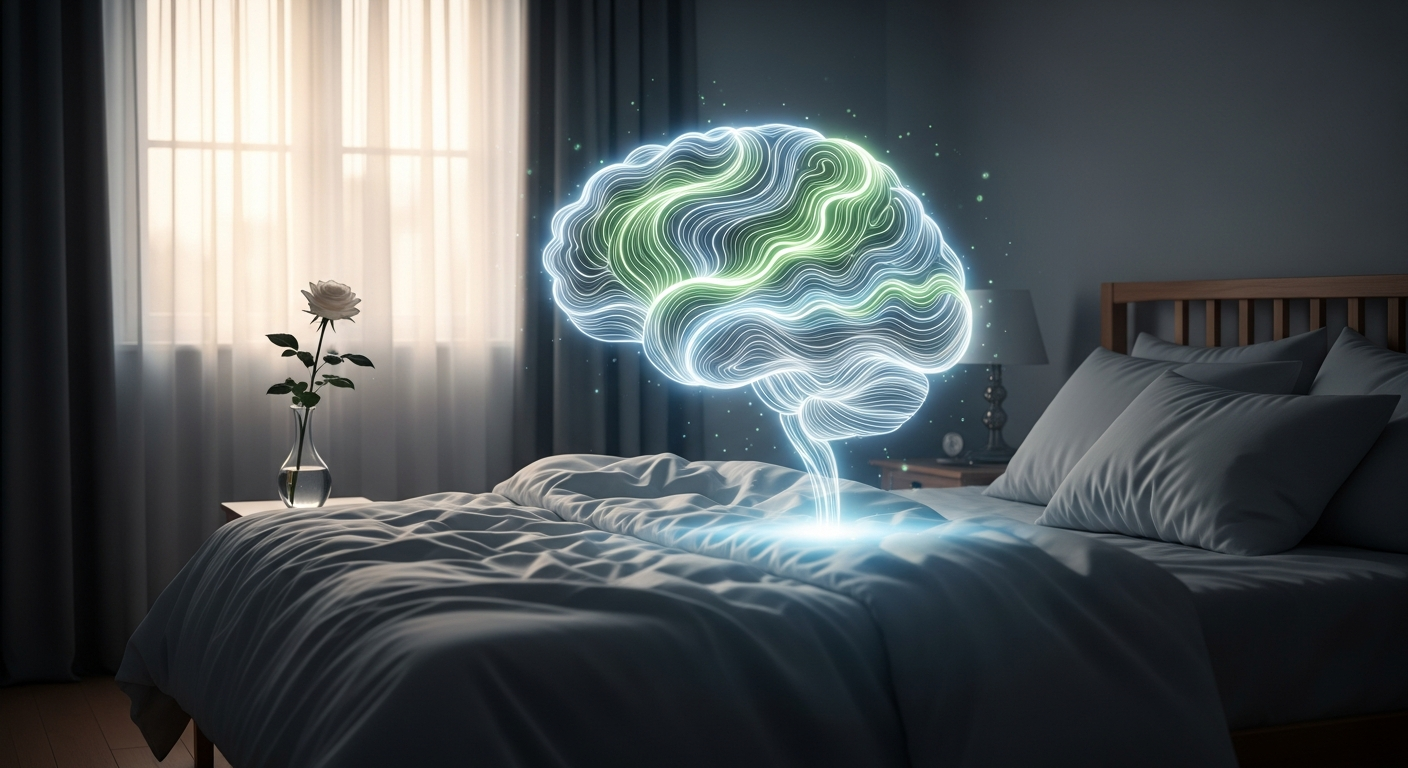 Sleep powers memory and brain cleanup.
The brain’s nightly maintenance shift
By Peter Teoh, Science Writer
Challenge to the reader: Tonight, record your actual sleep window. Then answer three questions with the tools in this post: (1) How many complete 90-minute cycles fit inside your sleep window? (2) If you drank a 300 mg cup of coffee at 4 pm, how much caffeine remains in your bloodstream at 11 pm (half-life 5.7 hours)? (3) What bedtime lands you at the end of a complete cycle for a 6:30 am wake-up — and why does an alarm set mid-cycle leave you groggy?
Sleep is not wasted time. It is the most powerful performance enhancer available to every human being, and it is completely free. While you are unconscious, your brain runs a maintenance program that no waking activity can substitute for: it flushes out metabolic waste, replays and strengthens the day’s memories, and resets the chemical systems that keep you alert. Skip it, and every other “optimization” — caffeine, supplements, productivity hacks — is just compensation for a self-inflicted deficit.
1. The core idea: sleep is maintenance, not downtime
The brain is never truly off. Sleep scientists model the sleep–wake cycle with the two-process model: a homeostatic drive (Process S) that builds up the longer you stay awake, and a circadian timer (Process C) that oscillates with a roughly 24-hour period, kept in sync by light. Sleep happens when Process S is high and Process C is in its permissive phase; waking happens when Process S has been discharged and Process C signals daytime.
The molecular currency of Process S is adenosine. Your cells burn ATP for energy, and adenosine is the leftover “spent fuel” that accumulates in the brain with every waking hour. The more adenosine, the stronger the pressure to sleep:
\[A(t) = A_{\max}\left(1 - e^{-t/\tau}\right),\]where $A(t)$ is the accumulated sleep pressure after $t$ hours awake and $\tau$ sets the rate of buildup. During sleep the brain clears adenosine with a half-life of roughly 1.8 hours, and the pressure falls away. This is the quantitative skeleton on which everything below hangs.
2. The glymphatic flush: how the brain takes out its trash
Every other organ can dump waste into the bloodstream and let the kidneys and liver deal with it. The brain cannot — it is sealed behind the blood–brain barrier and has no lymphatic vessels inside. So how does it clean itself?
The answer, discovered by Maiken Nedergaard’s team in 2012, is the glymphatic system. Cerebrospinal fluid is pumped along the spaces around blood vessels and through the brain tissue itself, washing metabolic debris — including amyloid-β, the protein implicated in Alzheimer’s disease — out toward the bloodstream. The name comes from its dependence on glial cells running a lymphatic-like clearance service.
The crucial finding: the flush runs mainly during slow-wave sleep. When you enter deep sleep, neurons shrink by up to 60%, widening the channels between cells and letting cerebrospinal fluid flow far more freely. Wakefulness is the brain’s rush hour — the highways are too crowded for the street sweepers to work.
Challenge (mid-post): Give two concrete reasons, based on this section, why the brain cannot simply flush continuously while you are awake. Then connect them to why an all-nighter leaves you mentally foggy even before you feel sleepy.
3. The architecture of a night: 90-minute cycles
Sleep is not one uniform state. Across the night the brain cycles through a repeating architecture:
- NREM stages 1 and 2 — light sleep; stage 2 features sleep spindles, brief bursts of activity linked to memory processing.
- NREM stage 3 — slow-wave sleep, the deepest stage, dominated by large, slow delta waves. This is when the glymphatic flush peaks.
- REM sleep — rapid eye movement sleep, when the brain is nearly as active as in wakefulness and dreams are most vivid.
One full cycle takes about 90 minutes, and a typical night packs in 4–6 cycles. The mix shifts across the night: deep slow-wave sleep dominates the first half, REM dominates the second. That is why cutting sleep from 8 hours to 6 hours does not cost you “20% of everything” — it costs you most of your REM:
\[\text{cycles} = \frac{\text{sleep duration}}{90\ \mathrm{min}}.\]A 7.5-hour night gives $7.5 \times 60 / 90 = 5$ complete cycles. A 6.2-hour night gives 4.1 cycles — the alarm yanks you out mid-cycle, and if that cycle is in slow-wave sleep, you pay for it with an hour of grogginess that no coffee fully fixes.
Challenge (mid-post): You aim for 7.5 hours but your alarm actually rings after 6.2 hours. Which stage of which cycle is the alarm most likely to interrupt, and why does waking from slow-wave sleep feel so much worse than waking from REM? (Hint: compare the brain states in each stage.)
4. The chemistry of sleep pressure: adenosine versus caffeine
This is where caffeine enters the story. Caffeine does not give you energy — it masks sleep pressure. Its molecule fits into the same receptors that adenosine binds to, blocking adenosine from delivering its signal. The pressure keeps building underneath; you simply stop feeling it. When the caffeine wears off, the entire unpaid debt hits at once.
Caffeine is eliminated exponentially, with a half-life of about 5.7 hours in a typical adult:
\[C(t) = C_0 \left(\frac{1}{2}\right)^{t/t_{1/2}}, \qquad t_{1/2} = 5.7\ \mathrm{h}.\]Plug in the numbers. A 300 mg coffee at 4 pm leaves
\[C(7\ \mathrm{h}) = 300 \times \left(\frac{1}{2}\right)^{7/5.7} \approx 128\ \mathrm{mg}\]at 11 pm — nearly half the dose, still circulating exactly when the brain is trying to sink into deep sleep. Even at 2 am about 90 mg remains. This is why “I can drink coffee after dinner and sleep fine” is usually an illusion: the sleep happens, but the deep, slow-wave portion — the glymphatic flush itself — is quietly degraded.
| Coffee time (300 mg) | Caffeine left at 11 pm | Roughly equivalent to |
|---|---|---|
| 8 am | $\approx 48\ \mathrm{mg}$ | half an espresso |
| 2 pm | $\approx 100\ \mathrm{mg}$ | a small coffee |
| 4 pm | $\approx 128\ \mathrm{mg}$ | a cup of tea |
| 7 pm | $\approx 185\ \mathrm{mg}$ | two-thirds of the original dose |
5. The night shift for memory: how sleep consolidates learning
Sleep is also when learning becomes durable. During slow-wave sleep the hippocampus — the brain’s short-term memory buffer — replays the day’s experiences at high speed, transferring them to the cortex for long-term storage. During REM the brain recombines memories in novel ways, which is why a problem that defeated you at night sometimes solves itself by morning.
The effect is measurable. Studies of motor-skill learning find that a night of sleep after practice improves performance by roughly 20% more than an equivalent period of wakefulness. Meanwhile the synaptic homeostasis hypothesis proposes that sleep scales down connections that grew during the day, keeping the network energy-efficient and restoring its capacity to learn again the next morning.
This closes the loop with Section 1: adenosine drives you to bed; sleep flushes waste (Section 2) and cycles through the architecture that times the flush and the memory work (Section 3); caffeine sabotages the exact stage that does the heavy lifting (Section 4).
6. The bill for skipping sleep: what deprivation actually costs
The costs are not subtle. After 16–18 hours awake, cognitive performance drops to a level comparable to a blood alcohol concentration of 0.05% — legally impaired for driving in many countries. Chronic short sleep measurably weakens immunity: in one well-known study, people sleeping 6 hours or less per night were more than four times as likely to catch a cold when deliberately exposed to the virus.
Longer term, chronic sleep deprivation is linked to higher risk of obesity, type 2 diabetes, cardiovascular disease, and dementia. The glymphatic connection from Section 2 is the likely thread: if amyloid-β clearance happens mainly in deep sleep, decades of shallow sleep may let the waste pile up silently.
7. The stages at a glance
| Stage | When it dominates | Brain signature | Main job |
|---|---|---|---|
| NREM 1–2 | throughout, especially early night | light sleep, sleep spindles | transition into sleep; spindle-driven memory transfer |
| NREM 3 (slow-wave) | first half of the night | large, slow delta waves | glymphatic flush; physical restoration |
| REM | second half of the night | active, dream-rich | emotional processing; creative recombination |
8. Deeper significance: why evolution pays the price of unconsciousness
From an evolutionary point of view, sleep looks like a terrible idea: an unconscious animal cannot flee predators, find food, or defend its young. Yet every animal studied so far sleeps — even dolphins, which solve the problem by sleeping one brain hemisphere at a time while the other keeps them swimming. A behavior that survives such a brutal cost–benefit test is not optional; it is load-bearing.
That is the deepest message of sleep science: the brain does not sleep despite being a brain. It sleeps because it is a brain. The wash cycle, the memory filing, the chemical reset — none of them can be skipped, only postponed, and the debt always comes due.
Final challenge: Design your own optimal night. (a) Choose a 6:30 am wake time and compute two bedtimes that land you at the end of a complete 90-minute cycle, assuming you take 15 minutes to fall asleep. (b) If you must be awake for 18 hours straight, use the caffeine table to choose the latest coffee time that leaves less than 50 mg in your blood at your 11:00 pm bedtime. (c) Using Process C, explain why sleeping until noon on weekends makes Monday mornings worse (“social jetlag”).
References
- Nedergaard, M. et al. (2013). “Sleep Drives Metabolite Clearance from the Adult Brain,” Science 342: 373–377. Glymphatic system
- Borbély, A. (1982). “A two process model of sleep regulation,” Human Neurobiology 1: 195–204. Two-process model
- Walker, M. (2017). Why We Sleep, Scribner. Sleep
- Prather, A. et al. (2015). “Behaviorally Assessed Sleep and Susceptibility to the Common Cold,” Sleep 38: 1353–1359.
- Tononi, G. & Cirelli, C. (2006). “Sleep function and synaptic homeostasis,” Sleep Medicine Reviews 10: 49–62. Sleep and memory
- Caffeine. Caffeine - Wikipedia
- Circadian rhythm. Circadian rhythm - Wikipedia
Leave a comment