What Does a 4-Dimensional Object Look Like?
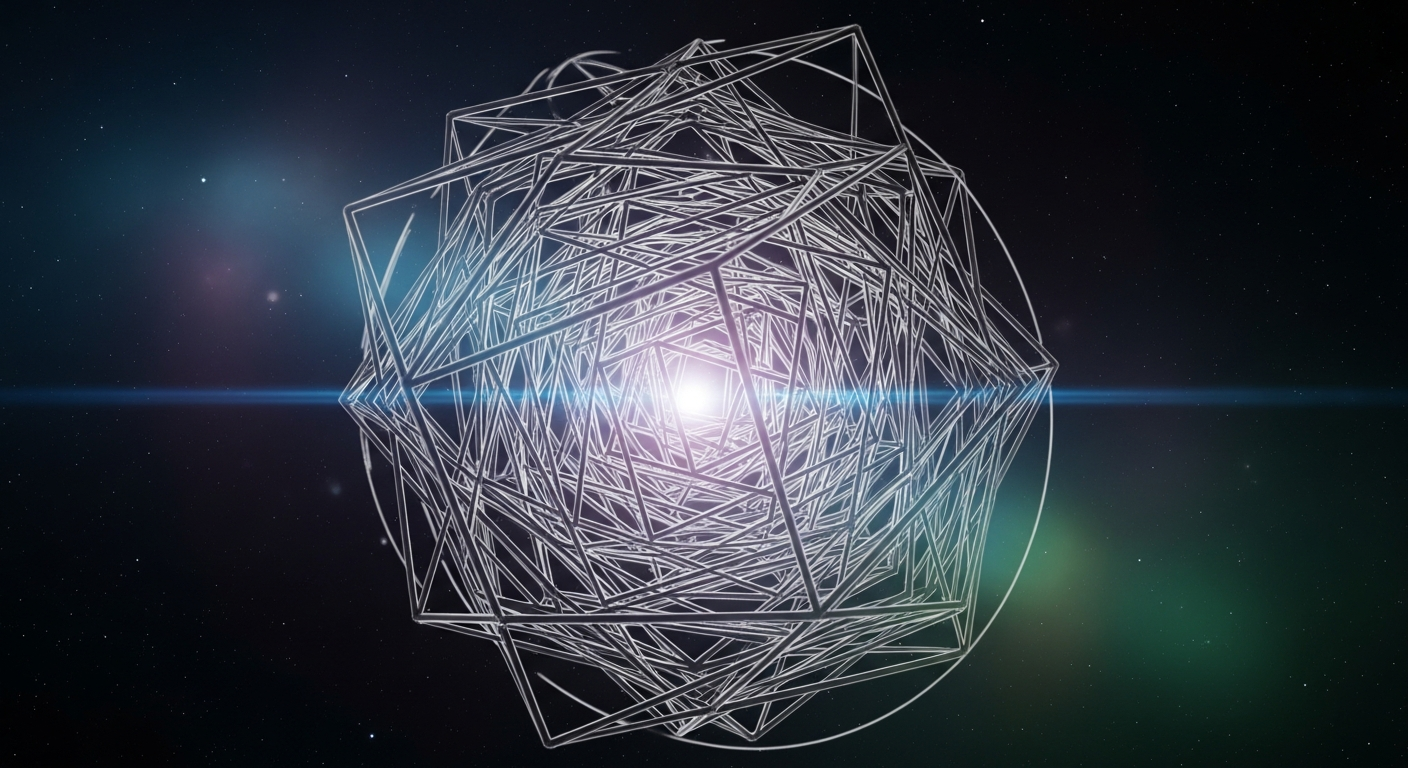 A tesseract projection: a 4D cube casting a 3D shadow.
Visualizing a world beyond 3D
By Peter Teoh, Science Writer
We cannot see four spatial dimensions, but we can still reason about them. Mathematicians use projections and slices to show how 4D objects behave when they pass through 3D space.
Explainer: From tesseracts to shadows
Focus: A tesseract is the 4D version of a cube. Just as a cube casts a square shadow, a tesseract can cast a 3D shadow that looks like a cube inside a cube with connecting edges. The projection distorts lengths, but it preserves the relationships between edges and faces.
Another tool is slicing. If a 4D object moved through 3D space, we would see a sequence of 3D cross-sections that grow, change, and shrink. This is the same way a CT scan rebuilds a 3D model from 2D slices.
Summary of Key Ideas:
- 4D objects can be studied by projections into 3D.
- Cross-sections act like slices of a higher shape.
- The math extends 3D rules to more dimensions.
Side Notes
- Hypercubes have 16 vertices and 32 edges.
- Distance formulas extend cleanly to any dimension.
Trending Sidebar
- 4D geometry in data visualization.
- Higher-dimensional puzzles and games.
Leave a comment