The Physics of Superheroes: Why Saving the World Would Turn You Into a Smear
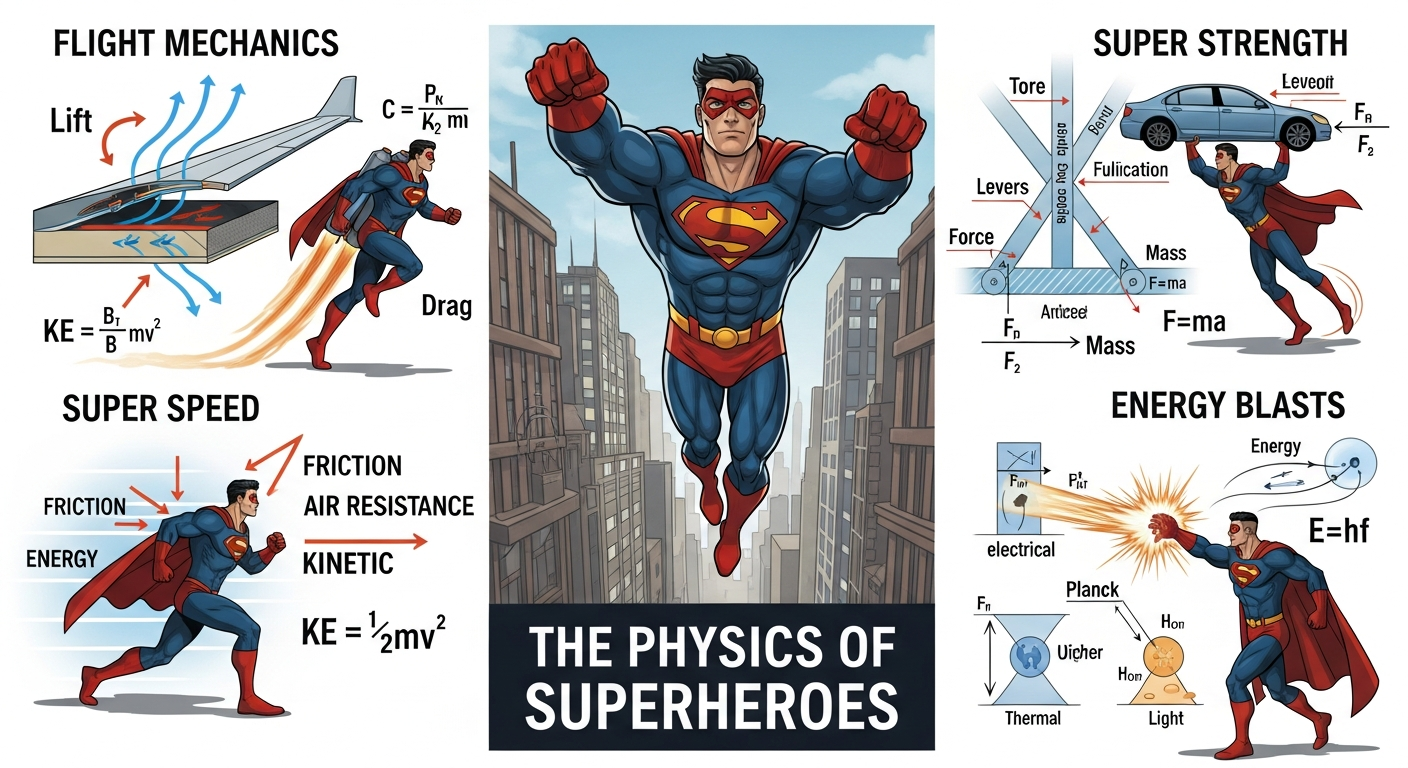 Superpowers collide with real-world physics.
Powers meet real-world forces
By Peter Teoh, Science Writer
Challenge to the reader: A 70 kg hero runs at Mach 1 ($343\ \mathrm{m/s}$). (1) Compute their kinetic energy and convert it to grams of TNT, given that 1 gram of TNT releases $4184\ \mathrm{J}$. (2) Now estimate the drag force on their body using $F_D = \tfrac{1}{2}\rho v^{2} C_d A$, with $\rho = 1.2\ \mathrm{kg/m^3}$, $C_d \approx 1.0$, and a frontal area $A \approx 0.7\ \mathrm{m^2}$. (3) Explain why both answers mean the hero needs more than super speed — they need super survivability.
Superhero feats are thrilling precisely because physics forbids them. Run at the speed of sound and the air hits you like a brick wall; catch a falling friend out of the sky and you break their ribs with kindness; lift a bus and the street beneath your feet gives way first. Physics does not kill the fun — it reveals the hidden price tag on every power.
1. The core idea: conservation laws do not take days off
Every superpower must obey the same bookkeeping that governs everything else: energy is conserved, momentum is conserved, forces come in pairs, and materials break. A superhero can be strong, fast, or invulnerable — but the ground they stand on, the air they run through, and the people they save are ordinary. The real drama of superhero physics is that the power is never the problem; the environment is.
This post runs the numbers on four classic powers: strength, speed, jumping, and flight. The calculations are first-year physics; the results are a body count.
2. Super strength: the ground breaks before you do
Suppose our hero lifts a school bus — say $10{,}000\ \mathrm{kg}$, a force of
\[F = mg = 10{,}000 \times 9.8 \approx 98\ \mathrm{kN}.\]The weight transfers to the ground through the hero’s two feet. A foot is about $0.025\ \mathrm{m^2}$, so the pressure underfoot is
\[P = \frac{F}{A} = \frac{98{,}000}{2 \times 0.025} \approx 2\ \mathrm{MPa}.\]Typical soil fails at a few hundred kPa and concrete at around 2–5 MPa. The hero punches through the pavement like a tent peg. The fix used by comics — “super strength plus normal ground” — is physically inconsistent: every force the hero exerts on the bus is matched by the ground pushing back on the hero, and ordinary ground cannot push back that hard. Real-world machinery solves this with outriggers, tracks, and massive foundations. A superhero would need to hover.
Challenge (mid-post): How much would the pressure underfoot drop if the hero’s feet were the size of snowshoes ($0.1\ \mathrm{m^2}$ each)? Would it now be safe to lift the bus on asphalt? Name one real-world machine that solves this problem the way your calculation suggests.
3. Super speed: the air becomes a wall — and a furnace
At superhuman speed, air stops being invisible and becomes a physical obstacle. The drag force grows with the square of the speed:
\[F_D = \tfrac{1}{2}\,\rho\, v^{2}\, C_d\, A.\]At Mach 1 ($v = 343\ \mathrm{m/s}$), our 70 kg hero feels
\[F_D = \tfrac{1}{2} \times 1.2 \times 343^{2} \times 1.0 \times 0.7 \approx 49\ \mathrm{kN}\]— the weight of five tonnes pressing backward on every square meter of frontal area. But drag is not the worst of it. Compressional heating raises the air temperature enormously at supersonic speeds: at Mach 2, the skin of an aircraft can reach several hundred degrees Celsius; at Mach 5, thousands. A hero running at Mach 10 through sea-level air would be surrounded by plasma, converting their own kinetic energy into a fireball:
\[E_k = \tfrac{1}{2} m v^{2} = \tfrac{1}{2} \times 70 \times 343^{2} \approx 4.1\ \mathrm{MJ} \approx 1\ \mathrm{kg}\ \text{of TNT}.\]That is the energy of a car bomb — carried as heat of motion by one running person. The Flash’s costume is the least unrealistic thing about him; the real problem is that every stride through real air would detonate the street.
4. The leap: how high could you really jump?
A leap converts crouched leg force into vertical speed, then trades speed for height:
\[v = \sqrt{2gh}.\]To clear a 100 m building, the hero needs
\[v = \sqrt{2 \times 9.8 \times 100} \approx 44\ \mathrm{m/s}\]of upward speed. That speed must be built over the crouch distance — call it $0.5\ \mathrm{m}$. The required acceleration is
\[a = \frac{v^{2}}{2d} = \frac{44^{2}}{2 \times 0.5} \approx 1960\ \mathrm{m/s^{2}} \approx 200\,g.\]Two hundred g’s. Fighter pilots black out at 9; a human body is structurally ruined long before 50. Note what this means: jumping is strength, and strength is acceleration. The same $200\,g$ would be required of the ground holding the hero up — back to Section 2’s broken pavement.
Challenge (mid-post): An Olympic high-jumper clears $2.4\ \mathrm{m}$ using a crouch of $0.3\ \mathrm{m}$. Work backward to compute their takeoff speed, then their leg acceleration in g’s. Why is the jump so much gentler than the superhero’s — and which single number would have to change for humans to jump 100 m?
5. Flight: the power bill of hovering
Superman hovering is a physics problem with a number attached. To hover, the hero must push air downward; the reaction force equals the weight:
\[F = \dot{m} v = mg,\]where $\dot{m}$ is the mass of air thrown downward per second and $v$ its speed. The mechanical power required is
\[P = \tfrac{1}{2} \dot{m} v^{2} = \tfrac{1}{2} mg v.\]Take a modest downward jet speed of $30\ \mathrm{m/s}$:
\[P = \tfrac{1}{2} \times 70 \times 9.8 \times 30 \approx 10\ \mathrm{kW}.\]Ten kilowatts just to stand still in the air — the continuous output of a small motorcycle engine, delivered by a body with no visible air intakes, exhaust, or wings. Fly forward at $100\ \mathrm{m/s}$, and the drag term from Section 3 adds another $50\ \mathrm{kW}$ or so. Flight without thrust — “superheroes just float” — requires not new physics but new biology: a source of tens of kilowatts inside a 70 kg body would require metabolizing food at roughly a hundred times the human rate, which is its own kind of superpower (see the final challenge).
6. The catch: why saving a falling friend kills them
The most beloved superhero moment is also the most lethal: catching a falling person just before they hit the ground. The problem is impulse — the change in momentum:
\[F = \frac{\Delta p}{\Delta t}.\]A 70 kg person at terminal velocity ($v \approx 53\ \mathrm{m/s}$) carries
\[\Delta p = 70 \times 53 \approx 3710\ \mathrm{kg\,m/s}.\]Catch them gently, decelerating over 1 meter: the stopping force is
\[F = \frac{\Delta p}{\Delta t} \approx 7\ \mathrm{kN}\]— survivable. But catch them “at the last instant,” decelerating over 10 cm, and the force multiplies by ten: $70\ \mathrm{kN}$, well over a hundred g’s, and the body tears apart at the point of contact — the arms, the ribs, everything the hero touches. The physics verdict is merciless: a person falling at terminal velocity is already dead unless decelerated over the same distance they fell. The hero who catches them at street level has simply moved the impact from the pavement into the rescue itself. (This is why safety nets, airbags, and stunt pads work — they extend the deceleration distance — and why “catching someone” cannot.)
7. The power bill at a glance
| Feat | Required physics | The hidden cost | Verdict |
|---|---|---|---|
| Lift a 10-ton bus | $98\ \mathrm{kN}$ through the feet | ground pressure $\approx 2\ \mathrm{MPa}$ | pavement fails first |
| Run at Mach 1 | $E_k \approx 4.1\ \mathrm{MJ}$ | drag $49\ \mathrm{kN}$; shock heating | fireball at Mach 10 |
| Leap 100 m | takeoff $44\ \mathrm{m/s}$ | $200\,g$ leg acceleration | body ruined |
| Hover | $\approx 10\ \mathrm{kW}$ | no air intakes, no exhaust | violates metabolism |
| Catch a faller | impulse $3710\ \mathrm{kg\,m/s}$ | $70\ \mathrm{kN}$ over 10 cm | the rescue kills them |
8. Deeper significance: physics is the final editor
Why bother? Because the exercise is a lesson in thinking with physics: every power is a budget. Strength is acceleration; speed is heat; flight is power; rescue is impulse. The four calculations are the same four equations — Newton’s second law, energy, momentum, and pressure — wearing costumes.
And there is a real-world payoff: these are exactly the budgets engineers face. Lifting a bus is why cranes have outriggers; catching a faller is why airbags exist; running at speed is why supersonic aircraft need thermal protection. The line between “superhero physics” and “safety engineering” is only the size of the numbers.
Final challenge: (a) Compute the power Superman would need to hover if he threw air downward at $100\ \mathrm{m/s}$ instead of $30\ \mathrm{m/s}$, and explain why throwing air faster is more efficient or less efficient (hint: re-derive the power from Section 5). (b) The hero catches the falling friend by matching speed first, flying downward alongside them, then decelerating together over 10 m. Recompute the force — why does this fix the rescue? (c) A “super strong” hero punches a concrete wall and stops their fist in 1 cm. If the fist moves at $20\ \mathrm{m/s}$ and the arm’s effective mass is 5 kg, compute the impact force — and name the real-world safety feature that works on the same principle in reverse.
References
- Kakalios, J. (2005). The Physics of Superheroes, Gotham Books. G-force
- Drag (physics). Drag (physics) - Wikipedia
- Impulse (physics). Impulse (physics) - Wikipedia
- Terminal velocity. Terminal velocity - Wikipedia
Leave a comment