You Are More Bacteria Than Human: The Invisible Empire Running Your Body From the Inside
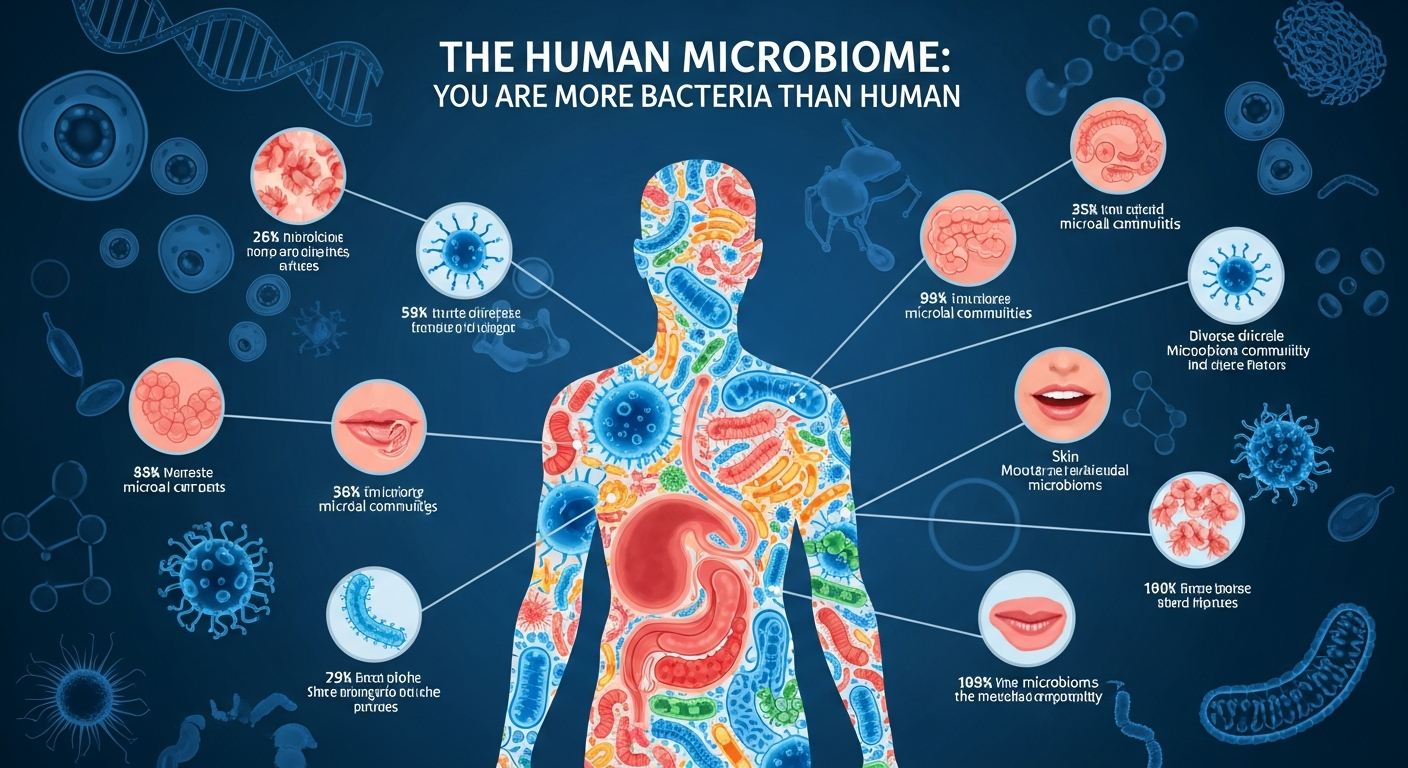 Your microbiome is a vast internal ecosystem.
Your hidden ecosystem
By Peter Teoh, Science Writer
Challenge to the reader: The old claim was that bacteria in your body outnumber your own cells 10 to 1. Modern estimates put the numbers at $3.8\times 10^{13}$ bacterial cells and $3.0\times 10^{13}$ human cells. (1) Compute the real ratio and state whether “you are more bacteria than human” is still literally true. (2) A single E. coli divides every 20 minutes. How many doublings — and how many hours — does it need to reach $10^{12}$ cells? (3) Use your answer to explain why your gut is not overrun within a day, and what keeps the ecosystem in balance.
There is a second genome inside you. Trillions of microbes — bacteria, archaea, fungi, and viruses — colonize your gut, skin, mouth, and every exposed surface, digesting food you cannot, manufacturing vitamins you cannot make, training the immune cells that protect you, and quietly influencing your mood. You have lived your entire life as a walking ecosystem, and until very recently, medicine largely ignored the other half of the partnership.
1. The core idea: you are a superorganism
The human body is not a single organism but a superorganism: one human genome cooperating with the microbiome — the collection of microbes and their genes that live in and on us. The human genome contains about 20,000 protein-coding genes; the gut microbiome alone is estimated to carry 2–20 million microbial genes — a hundred to a thousand times the human count. Biologically speaking, most of the metabolic chemistry in “your” body is not performed by your cells.
This reframes health entirely. Every meal you eat is a joint project; every immune decision your body makes is influenced by residents with their own evolutionary interests; every course of antibiotics is a mass extinction event inside an ecosystem you depend on.
2. The real numbers: debunking the 10-to-1 myth
The famous claim — “bacteria outnumber human cells 10 to 1” — traces back to a 1972 back-of-the-envelope estimate that put total bacteria at $10^{14}$ cells. In 2016, Ron Sender, Shai Fuchs, and Ron Milo recalculated using modern data and found both numbers had been wrong:
\[\frac{\text{bacterial cells}}{\text{human cells}} = \frac{3.8\times 10^{13}}{3.0\times 10^{13}} \approx 1.3.\]Bacteria still win — but only by about 30%, not tenfold. The revision is a lovely case study in scientific self-correction: the original estimate overestimated gut bacteria (the colon holds most of them) and underestimated the true number of human cells, especially red blood cells.
The mass accounting is equally surprising. A typical bacterium is about $1\ \mu\mathrm{m}$ long and weighs about $10^{-12}\ \mathrm{g}$, so the entire microbial population masses
\[3.8\times 10^{13} \times 10^{-12}\ \mathrm{g} \approx 0.4\ \mathrm{kg}\]— roughly the weight of a hamster, or less than 1% of your body weight. The empire is vast in numbers, modest in mass, and almost unimaginable in genetic diversity.
Challenge (mid-post): Verify the ratio calculation. Then recompute the old claim honestly: if bacteria really were $10^{14}$ cells, what ratio would that give? What must the 1972 estimate have gotten wrong for the modern number to be ten times smaller?
3. Where they live and what they make
The gut is the microbial capital, and its economy runs on fiber — the plant material your own enzymes cannot break down. Gut bacteria ferment fiber into short-chain fatty acids (SCFAs): acetate, propionate, and butyrate. Butyrate is the headline product: it is the preferred fuel of your colon’s own cells, it tightens the gut lining, and it exerts anti-inflammatory signals throughout the body.
The microbes also:
- Make vitamins — vitamin K and several B vitamins are synthesized by gut bacteria.
- Train the immune system — from birth, the microbiome teaches immune cells to tolerate harmless residents and attack pathogens. Germ-free mice (born and raised without microbes) have half-formed immune systems.
- Compete with pathogens — a healthy, dense microbiome physically crowds out invaders like Salmonella or C. difficile, a defense called colonization resistance.
- Signal to the brain — microbes produce neurotransmitters including serotonin precursors and GABA. About 90% of the body’s serotonin is produced in the gut, much of it with microbial involvement.
In energy terms the fermentation payoff is real: SCFAs supply an estimated 5–10% of a Western adult’s daily calories — free energy extracted from food your own genome cannot touch.
4. The growth math: why they don’t take over
The most unnerving fact about gut bacteria is how fast they can multiply. E. coli divides every 20 minutes in ideal conditions — exponential growth:
\[N = N_0 \times 2^{n}.\]One bacterium, doubling every 20 minutes, reaches $10^{12}$ cells in
\[n = \log_2 10^{12} \approx 40\ \text{doublings}, \qquad 40 \times 20\ \mathrm{min} \approx 13\ \text{hours}.\]Half a day to go from one cell to a trillion. So why isn’t every meal fatal? Because the gut is not ideal conditions — it is a crowded, competitive ecosystem at carrying capacity. Food is limited, transit time is short (the gut empties in tens of hours), and thousands of species fight for every niche. In ecological language, growth is not exponential but logistic:
\[\frac{dN}{dt} = rN\left(1 - \frac{N}{K}\right),\]where $K$ is the carrying capacity. As the population approaches $K$, growth slows to zero — which is why the microbiome is stable: it is an ecosystem, not a culture flask.
Challenge (mid-post): In the logistic equation, find the population at which growth is fastest (hint: maximize $rN(1-N/K)$), and explain why “fastest growth at half capacity” describes both recovering gut ecosystems and why a microbiome half-destroyed by antibiotics regrows explosively — and often chaotically.
5. The gut–brain axis: your second nervous system
The gut is lined with a network of some 500 million neurons — the enteric nervous system, nicknamed the “second brain” — connected to the central nervous system by the vagus nerve. Traffic runs both ways: stress changes gut motility and the microbiome; the microbiome, in turn, produces metabolites that reach the brain.
The evidence for a genuine gut–brain dialogue has accumulated rapidly:
- Germ-free mice show altered anxiety-like behavior, which normalizes when colonized.
- Transplanting microbiota between mouse strains transfers aspects of their behavior.
- Probiotic and diet interventions show modest but reproducible effects on mood in human trials.
The mechanism is chemical: microbial SCFAs, tryptophan metabolism (the serotonin precursor), and immune signals all cross into the brain’s regulatory circuits. Your gut bacteria are not passengers in your nervous system — they are peripheral participants in it.
6. When the ecosystem collapses: antibiotics and C. difficile
A course of broad-spectrum antibiotics is an asteroid strike on the microbiome: diversity collapses within days, and recovery takes months — sometimes years — and is often incomplete. The most dramatic consequence is Clostridioides difficile infection: with its competitors wiped out, this antibiotic-resistant pathogen explodes and causes severe, sometimes fatal, colitis.
The treatment that works is the most direct microbiome therapy ever devised: fecal microbiota transplantation (FMT) — transferring a healthy donor’s gut community into the patient’s colon, restoring the ecosystem in one procedure. Cure rates of roughly 90% in recurrent C. difficile infection, versus about 30% for repeated antibiotics, made FMT the proof of concept for the whole field: an ecosystem disease requires an ecosystem treatment.
7. The microbiome at a glance
| Contribution | Mechanism | Consequence |
|---|---|---|
| Digestion | fermentation of fiber to SCFAs | 5–10% of daily calories recovered |
| Vitamins | microbial synthesis | vitamin K, B vitamins |
| Immunity | early-life education of immune cells | tolerance + pathogen defense |
| Pathogen defense | colonization resistance | crowds out C. difficile, Salmonella |
| Brain signaling | SCFAs, neurotransmitters, vagus nerve | mood, appetite, stress response |
| Barrier function | butyrate feeds colon cells | tighter gut lining, less inflammation |
8. Deeper significance: the microbiome as an organ
The microbiome is best understood as an acquired organ: it is not encoded in your genome, it is assembled after birth from your environment — delivery mode, diet, antibiotics, and the people you live with. It is also modifiable, which is its medical promise: unlike a defective human gene, an unbalanced microbiome can in principle be rebalanced with diet, prebiotics (fiber that feeds beneficial species), probiotics, or transplantation.
The research frontier is personalization: the same diet produces different blood-sugar responses in different people, predicted far better by their microbiome than by calories alone. The deeper lesson is humility — the “self” is a federation. Every decision you attribute to your own body is the output of two genomes negotiating, and your health is a property of the whole ecosystem, not just the human part.
Final challenge: (a) Your gut bacteria produce 500 mmol of butyrate per day (molar mass $88\ \mathrm{g/mol}$, about $25\ \mathrm{kJ}$ of food energy per gram). Compute the mass and the daily energy contribution in kJ, and compare it to a 2000 kcal diet (1 kcal = 4.184 kJ). (b) Using the doubling-time math, estimate how many hours a single surviving E. coli needs to repopulate the colon after antibiotics — and why the diversity lost takes far longer to return than the raw cell count. (c) Design a two-step microbiome intervention for a patient with recurrent C. difficile: first explain why antibiotics alone keep failing, then propose what the cure must deliver and why it works.
References
- Sender, R., Fuchs, S. & Milo, R. (2016). “Revised Estimates for the Number of Human and Bacteria Cells in the Body,” PLOS Biology 14: e1002533.
- van Nood, E. et al. (2013). “Duodenal Infusion of Donor Feces for Recurrent Clostridium difficile,” New England Journal of Medicine 368: 407–415.
- Koh, A. et al. (2016). “From Dietary Fiber to Host Physiology: Short-Chain Fatty Acids as Key Bacterial Metabolites,” Cell 165: 1332–1345.
- Human microbiome. Human microbiome - Wikipedia
- Gut microbiota. Gut microbiota - Wikipedia
Leave a comment