Building with Atoms: The Strange Physics That Only Exists When Things Get Small
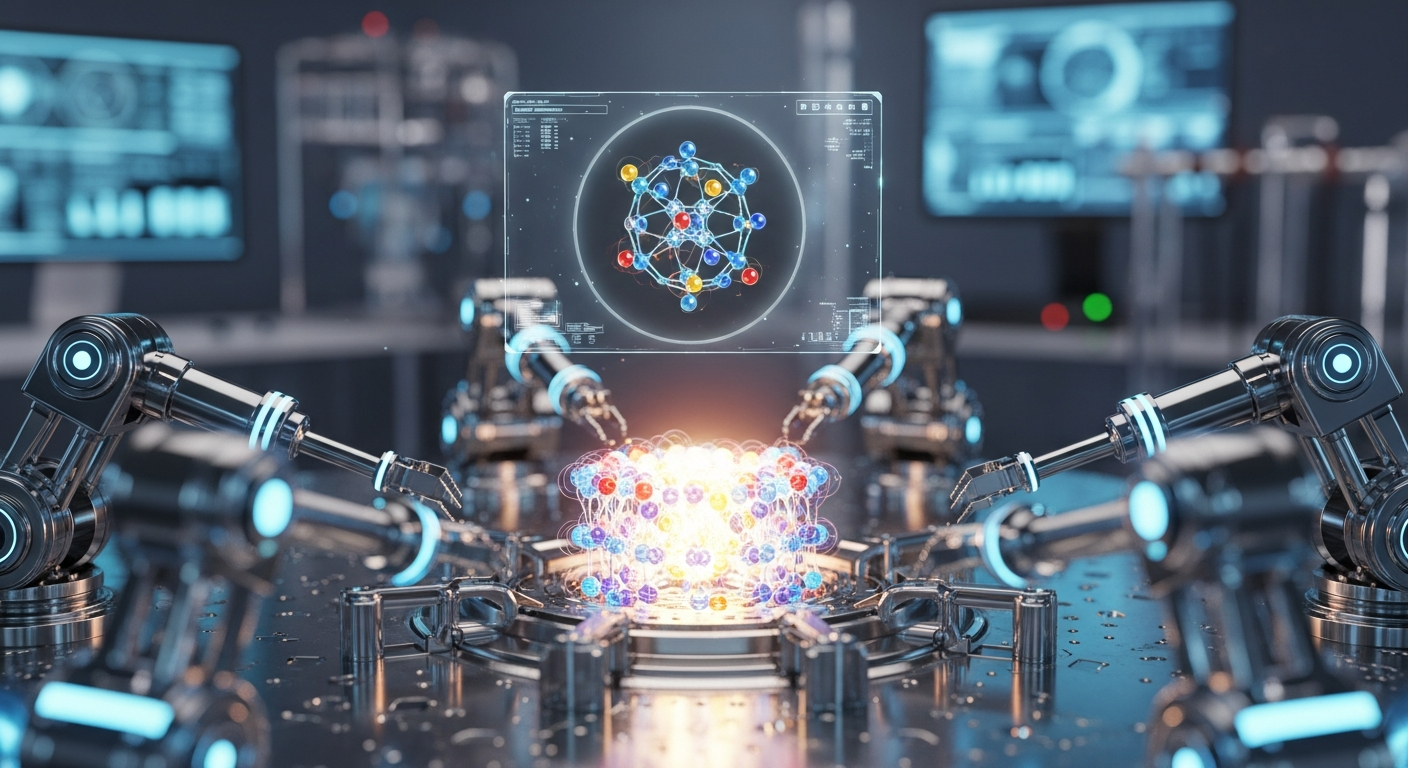 Nanotechnology builds materials atom by atom.
Tiny structures, big effects
By Peter Teoh, Science Writer
Challenge to the reader: Take a sugar cube, $1\ \mathrm{cm}$ on each side. (1) What is its surface area? (2) If you ground it into $10^{21}$ cubes of $1\ \mathrm{nm}$ each, what would the total surface area become — in square meters — and what familiar object is about that size? (3) Use your answer to explain why nanoscale materials are dramatically more chemically reactive than the same substance in bulk.
Between the world of molecules and the world of everyday objects lies a strange middle ground — the nanoscale, from 1 to 100 nanometers. A nanometer is a billionth of a meter: ten hydrogen atoms, lined up. At this scale, materials stop behaving like their bulk selves. Gold stops being gold-colored, insulators start conducting, and ordinary surface area balloons into a soccer field. Nanotechnology is the engineering of this middle world — building materials from the bottom up, atom by atom.
1. The core idea: below 100 nm, the rules change
Two physical effects dominate the nanoscale:
- Surface effects — as objects shrink, a larger fraction of their atoms live on the surface, where they interact with the outside world.
- Quantum effects — when structures approach the size of the electron’s wavelength, electrons behave like confined waves, and their allowed energies change.
Neither effect matters for a brick; both dominate for a 5-nanometer particle. This is the entire premise of nanotechnology: size is a dial that tunes material properties, no new elements required.
2. The surface-area explosion
The surface-to-volume ratio of a cube of side $L$ is
\[\frac{\text{SA}}{\text{V}} = \frac{6L^{2}}{L^{3}} = \frac{6}{L}.\]The ratio grows like $1/L$ — halve the size, double the relative surface. A $1\ \mathrm{cm}$ sugar cube has
\[\text{SA} = 6 \times (10^{-2}\ \mathrm{m})^{2} = 6\times 10^{-4}\ \mathrm{m^{2}}\]— the size of a postage stamp. Now split it into $1\ \mathrm{nm}$ cubes:
\[\text{number of cubes} = \left(\frac{10^{-2}}{10^{-9}}\right)^{3} = 10^{21},\]and the total surface area becomes
\[10^{21} \times 6 \times (10^{-9})^{2} = 6\times 10^{3}\ \mathrm{m^{2}}\]— six thousand square meters, a full soccer field, from one sugar cube. Every square meter is reaction surface. This is why nanoscale catalysts work so well: the same mass of platinum, spread as nanoparticles, presents thousands of times more active surface for chemistry. It is also why nanopowders can be explosive (see the companion post on fire) and why nano-sized sunscreen particles spread so smoothly — the physics of $1/L$.
Challenge (mid-post): Rework the calculation for cubes of $10\ \mathrm{nm}$ instead of $1\ \mathrm{nm}$: how many cubes, and what total surface area? Compare to the $1\ \mathrm{nm}$ answer and explain why every factor of ten in size multiplies the surface by ten.
3. Quantum effects: gold that is not gold-colored
The most famous nanoscale surprise is color. Bulk gold is yellow — the color of jewelry, stable for millennia. But a suspension of 10–100 nm gold particles is ruby red; ancient Roman glassmakers unknowingly made “gold ruby” glass centuries before anyone understood why.
The reason is quantum confinement plus electrostatics: in a gold nanoparticle, the free electrons are confined to a box smaller than their natural collective oscillation. Light of the right frequency sets them sloshing back and forth — a surface plasmon resonance — absorbing green light and scattering red. The color depends on particle size: 10 nm particles glow red, 50 nm particles scatter orange. The same metal, tuned by geometry alone, spans the rainbow.
Confined electrons also change electronic structure: semiconductor nanoparticles called quantum dots shift their emission color with diameter, because the confinement energy scales roughly as
\[E \sim \frac{1}{L^{2}}.\]Smaller dot, bluer light. Quantum dots are now used in high-end displays and as fluorescent tags in biological imaging — wavelengths set not by chemistry but by size.
4. Self-assembly: borrowing nature’s factory
Nanotechnology’s dirty secret is that most “building with atoms” is not done by robots — it is done by self-assembly: molecules that arrange themselves. Nature has been running this factory for billions of years:
- Cell membranes assemble themselves from lipid molecules whose water-loving heads and oil-loving tails spontaneously form double layers.
- Viruses self-assemble: protein subunits snap together around the genome into precise shells, like folding furniture assembling itself.
- DNA origami — a human-designed trick — folds a long DNA strand into designed two- and three-dimensional shapes by adding short “staple” strands that pin it in place, producing nanoscale smiley faces, boxes, and drug-delivery cages.
The lesson is humbling: the cell is the original nanofactory, and the most sophisticated nanoscale machines we know are the ones we did not build.
5. The scaling laws: why ants are strong and giants collapse
The $1/L$ logic applies to animals too. Strength comes from muscle and bone cross-sectional area, which scales with length squared:
\[\text{strength} \sim L^{2},\]while weight scales with volume:
\[\text{weight} \sim L^{3}.\]The ratio of strength to weight therefore scales as
\[\frac{\text{strength}}{\text{weight}} \sim \frac{L^{2}}{L^{3}} = \frac{1}{L}.\]An ant, a few millimeters long, carries 50 times its body weight — not because ants are magical, but because everything small is proportionally strong. A human scaled up tenfold (to 18 m, the movie giant) would weigh $10^{3} = 1000$ times more while its bones carried only $10^{2} = 100$ times the load — a tenfold stress overload, and the legs shatter. This is why elephants have pillar-thick legs, why whales can only survive in water (buoyancy spares the skeleton), and why a movie giant is a physics impossibility. The nanoscale is just the endpoint of a rule that governs every structure in nature.
Challenge (mid-post): A flea jumps 30 cm. If a human could jump with the same energy per body mass, how high would a human jump? (Hint: energy scales as $L^{3}$ too — which is why the flea’s achievement is not transferable.) Then explain, using strength/weight scaling, why the flea’s jump height is exactly what the scaling law predicts for its size.
6. What we build with it today
Nanotechnology is not a future promise — it is current industry:
- Catalysis — catalytic converters and industrial chemistry run on nanoparticles that maximize surface area (Section 2).
- Medicine — nanoparticle carriers deliver chemotherapy to tumors; lipid-nanoparticle delivery is the backbone of the mRNA COVID vaccines; iron-oxide nanoparticles sharpen MRI images.
- Materials — carbon nanotubes and graphene (see the companion post on carbon allotropes) stiffen composites; nano-coatings make surfaces water-repellent or self-cleaning.
- Electronics — the chips in your phone are manufactured at nodes of a few nanometers; a 2 nm feature is only about four silicon unit cells wide. Moore’s law has carried computing straight into the quantum-confined regime, which is exactly where the trouble — and the opportunity — now lies.
| Scale | Example | Dominant physics |
|---|---|---|
| 1 m | a sugar cube | gravity, bulk properties |
| 1 mm | a grain of sand | surface tension starts to matter |
| 10 µm | a red blood cell | viscosity dominates; gravity negligible |
| 100 nm | a virus | surface effects dominate |
| 10 nm | a quantum dot | quantum confinement |
| 1 nm | ten hydrogen atoms | the molecular world |
7. Deeper significance: Feynman’s room at the bottom
The field’s founding manifesto is Richard Feynman’s 1959 lecture, There’s Plenty of Room at the Bottom: “The principles of physics, as far as I can see, do not speak against the possibility of maneuvering things atom by atom.” Sixty-five years later, that prophecy is routine — scanning-probe microscopes push individual atoms into letters and logos, and self-assembled structures are engineered daily.
The deeper significance is that the nanoscale is where all of science meets. Chemistry owns the molecules, physics owns the quantum effects, biology owns the self-assembly, and engineering owns the intent. The future of medicine, energy, and computing will be decided in the middle world — because that is where the rules stop being intuitive and start being powerful.
Final challenge: (a) A 10 nm gold particle contains roughly 30,000 atoms. Estimate what fraction of them sit on the surface, using the surface-layer thickness of one atomic diameter ($0.29\ \mathrm{nm}$) and the surface-to-volume ratio $6/L$ — and compare your answer to the fraction for a $1\ \mathrm{mm}$ grain of gold. (b) Using Section 5, compute the bone stress of an 18 m giant relative to a 1.8 m human, and state why the giant collapses. (c) A quantum dot’s emission energy scales as $1/L^{2}$. If a 6 nm dot emits red light (650 nm wavelength, energy 1.9 eV), what color would a 3 nm dot emit — and why can a chemist tune a display’s colors without changing a single element?
References
- Feynman, R. P. (1959). “There’s Plenty of Room at the Bottom,” Caltech lecture. Nanotechnology
- Faraday, M. (1857). “The Bakerian Lecture: Experimental Relations of Gold (and Other Metals) to Light,” Philosophical Transactions 147: 145. Colloidal gold
- Rothemund, P. W. K. (2006). “Folding DNA to create nanoscale shapes and patterns,” Nature 440: 297–302. DNA origami
- Nanoparticle. Nanoparticle - Wikipedia
- Quantum dot. Quantum dot - Wikipedia
Leave a comment