CRISPR’s Secret: How a Virus-Killing Defense Became Our Most Precise Editing Tool
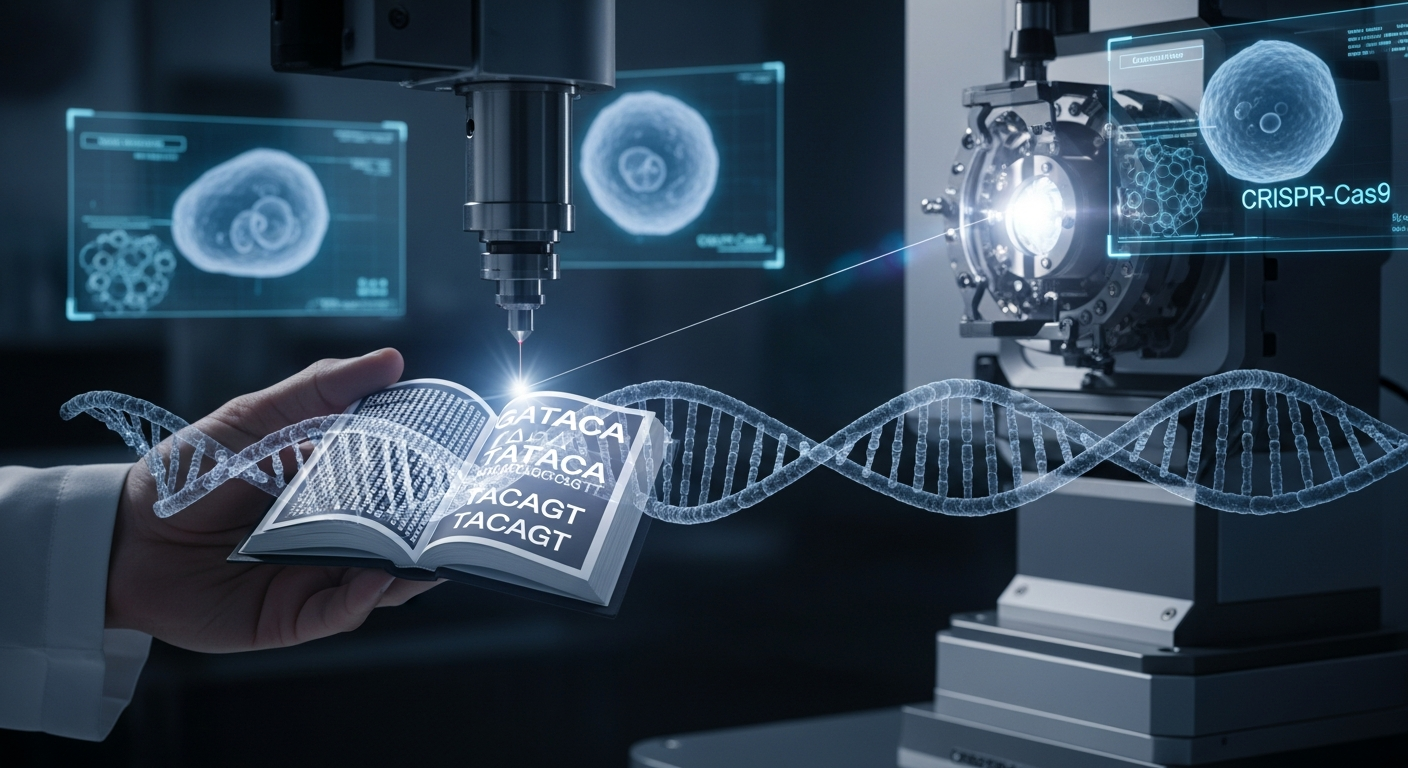 CRISPR lets scientists edit DNA with precision.
A molecular scalpel borrowed from bacteria
By Peter Teoh, Science Writer
Challenge to the reader: The human genome contains about $3.2\times 10^{9}$ base pairs, and a CRISPR guide RNA matches a target 20 letters long. (1) Show that there are $4^{20} \approx 1.1\times 10^{12}$ possible 20-letter DNA sequences, and estimate how many random matches a 20-letter guide would find in the human genome. (2) Now add the PAM requirement (NGG): compute how many PAM-eligible sites exist in the genome. (3) Explain, from your two answers, why CRISPR’s specificity is a numbers game — and why it can still go wrong.
CRISPR is a gene-editing system adapted from a bacterial immune defense. It lets scientists search a three-billion-letter genome, find one specific 20-letter sentence, and cut it — precisely, cheaply, and in a matter of days. What took other editing methods months of custom protein engineering, CRISPR does with a molecule of RNA that can be ordered online and designed on a laptop.
1. The core idea: find, cut, repair
The CRISPR system is a two-piece machine:
- Guide RNA — a 20-letter RNA molecule whose sequence is complementary to the DNA you want to edit. It is the “search query.”
- Cas9 — the enzyme that does the cutting. It grips the guide RNA and scans the genome until the guide’s 20 letters pair up with a matching DNA stretch.
Before Cas9 will cut, the target must be followed by a short marker sequence called the PAM (protospacer adjacent motif). For the most common Cas9, the PAM is NGG — any base followed by two guanines. The PAM is how Cas9 distinguishes enemy DNA from its own genome: bacteria do not put NGG motifs next to the CRISPR sequences in their own genome, so Cas9 never turns on its host.
Once the cut is made, the cell’s own repair machinery takes over — and the edit happens in the repair.
2. The search problem: how specific is 20 letters?
Why is a 20-letter guide enough to find one spot in three billion? Because DNA has only four letters — A, T, G, C — and sequences are essentially random, the number of possible 20-letter targets is
\[4^{20} = 1{,}099{,}511{,}627{,}776 \approx 1.1\times 10^{12}.\]The human genome has only $3.2\times 10^{9}$ base pairs, so the expected number of random exact matches for any one guide is
\[\frac{3.2\times 10^{9}}{4^{20}} \approx 0.003.\]A random 20-letter guide will almost never match anywhere — yet the genome is full of non-random structure, and biology is not statistics. Real guides do find off-target sites, because Cas9 tolerates mismatches: a site that matches 17 or 18 of the 20 letters can still be cut. That is where the errors creep in, and Section 5 puts numbers on it.
The PAM requirement tightens the search further. NGG means the last two letters of a 3-letter motif are fixed, so only
\[\frac{3.2\times 10^{9}}{4^{2}} \approx 2\times 10^{8}\]positions are even eligible. The guide plus the PAM together specify a 23-letter signature — and $4^{23} \approx 7\times 10^{13}$, far larger than the genome.
Challenge (mid-post): A particular guide has a perfect target on chromosome 7, but the same 20-letter sequence also appears once on chromosome 3 — except there it is not followed by NGG. Will Cas9 cut the chromosome 3 site? Explain, and name the molecule whose shape does the “proofreading” in each case.
3. How the repair goes wrong — or right
Cas9 cuts both strands of DNA in the same place, producing a double-strand break — the most alarming damage a cell can suffer. The cell must repair it, and it has two options:
- NHEJ (non-homologous end joining) — the fast, sloppy emergency fix. The cell glues the broken ends back together, usually deleting or adding a few letters in the process. If the cut lands inside a gene, these small errors usually disable the gene. This is how researchers knock a gene out.
- HDR (homology-directed repair) — the slow, precise fix. If the cell is given a donor template with matching ends, it can copy the template across the break, inserting whatever new sequence the experimenter supplies. This is how genes are corrected or added.
The two pathways are the entire editing toolkit: break a gene with NHEJ, or rewrite a gene with HDR. Everything else in gene editing is about steering which one the cell chooses.
4. The origin story: an arms race billions of years old
CRISPR was not invented in a lab; it was discovered. Bacteria are locked in a permanent war with bacteriophages — viruses that infect them — and CRISPR is their immune memory. When a bacterium survives a phage attack, it snips a fragment of the invader’s DNA and stores it in its own genome, in a region of clustered, regularly interspaced repeats: CRISPR. Each stored fragment sits between repeated spacers like a photograph in a family album.
If the same phage attacks again, the bacterium transcribes its collection of stored fragments into RNA, loads them onto Cas enzymes, and sends the complex out as a patrol. A fragment that matches the incoming phage DNA triggers the scissors: the virus is shredded by a search-and-destroy system that remembers its enemies forever.
Scientists realized this was a programmable enzyme: swap in any 20-letter RNA, and Cas9 cuts wherever it matches. The breakthrough papers by Emmanuelle Charpentier and Jennifer Doudna in 2012 — and the first editing of human cells in 2013 — turned a bacterial weapon into a general-purpose tool, earning the 2020 Nobel Prize in Chemistry.
5. The off-target math: why perfect specificity is hard
The practical risk of CRISPR is not that it will miss its target, but that it will hit other targets too. Cas9 tolerates a few mismatches between guide and DNA, especially far from the PAM. Suppose a guide cuts anywhere the match has at most 2 mismatches out of 20. The number of DNA sequences within 2 mismatches of a given 20-mer is
\[\binom{20}{0} + \binom{20}{1}\times 3 + \binom{20}{2}\times 3^{2} = 1 + 60 + 1710 = 1771.\]So for every perfect target, there are up to 1,771 near-miss sequences that could also be cut. The genome is big enough that a careless guide really can hit an unintended gene — which is why modern guide design scores candidates against the entire genome before any experiment, and why base editors and prime editors (newer enzymes that change single letters or rewrite short stretches without making a double-strand break) were developed to cut risk further.
Challenge (mid-post): Verify the arithmetic above. Then compute the same sum for “at most 1 mismatch” — how many near-miss sequences remain, and why does that shrink the off-target danger dramatically?
6. What CRISPR can do today
The tool has moved from the bench to the clinic, and the breadth is startling:
- Sickle cell disease and beta-thalassemia — the first CRISPR therapy, exagamglogene autotemcel (Casgevy), was approved in 2023. Blood stem cells are taken from the patient, edited to switch on fetal hemoglobin, and returned. The disease is caused by a single letter change in the HBB gene — a single A-to-T substitution among three billion base pairs.
- Base editing — enzymes that chemically convert one letter to another (C to T, or A to G) without cutting the DNA at all.
- Prime editing — a “search-and-replace” system that writes a new sequence of up to a few dozen letters into a chosen spot.
- Gene drives — CRISPR systems engineered to copy themselves into every offspring of a species, proposed as a way to control malaria mosquitoes, with consequences that demand extreme care.
- Diagnostics — CRISPR-based tests that recognize a specific pathogen’s sequence and then signal its presence, the basis of rapid, cheap detection platforms.
The pattern is the same in every case: a 20-letter search query plus a molecular pair of scissors.
7. CRISPR at a glance
| Method | Era | How it finds the target | Cost and speed | Precision |
|---|---|---|---|---|
| ZFNs | 1996 | custom zinc-finger proteins | months of protein engineering, expensive | high, but laborious |
| TALENs | 2010 | custom TALE proteins | weeks, expensive | high, less laborious |
| CRISPR-Cas9 | 2012 | 20-letter guide RNA | days, a few dollars per guide | high; off-targets manageable |
| Base editing | 2016 | guide RNA + deaminase | days | single letters, no double-strand break |
| Prime editing | 2019 | guide RNA + reverse transcriptase | days | small insertions and substitutions |
8. Deeper significance: the power and the responsibility
CRISPR is the first tool that makes the genome genuinely editable — as approachable as editing text. The promise is enormous: curing single-gene diseases, engineering climate-resistant crops, studying every gene’s function directly. The burden is equal: editing human embryos would change not just a patient but all their descendants, and off-target edits are errors written into a person’s permanent record.
The deeper lesson is about science itself: the most powerful tool in modern biology was not designed — it was found — in a war between bacteria and viruses that has raged for billions of years. Nature had already solved the search-and-cut problem; we only needed to learn its language.
Final challenge: A researcher wants to disrupt a gene whose sequence around the target site reads ...TAGCGATCGTACGTACGTACG NGG... (the NGG PAM is shown). (a) Write the 20-letter guide RNA sequence that matches this target. (b) Explain why the PAM must not be included in the guide. (c) Using the Section 5 calculation, explain how many mismatched sites would need to be screened against a 3.2-billion-base genome to pick a guide with no off-targets — and why guide-design software computes a “score” rather than a guarantee.
References
- Jinek, M., Chylinski, K., Fonfara, I., Hauer, M., Doudna, J. A., Charpentier, E. (2012). “A programmable dual-RNA–guided DNA endonuclease in adaptive bacterial immunity,” Science 337: 816–821.
- Cong, L. et al. (2013). “Multiplex genome engineering using CRISPR/Cas systems,” Science 339: 819–823.
- Anzalone, A. et al. (2019). “Search-and-replace genome editing without double-strand breaks or donor DNA,” Nature 576: 149–157.
- Frangoul, H. et al. (2021). “CRISPR-Cas9 Gene Editing for Sickle Cell Disease and β-Thalassemia,” New England Journal of Medicine 384: 252–260.
- CRISPR. CRISPR - Wikipedia
- Genome editing. Genome editing - Wikipedia
Leave a comment