The mysterious numbers that never repeat but always return
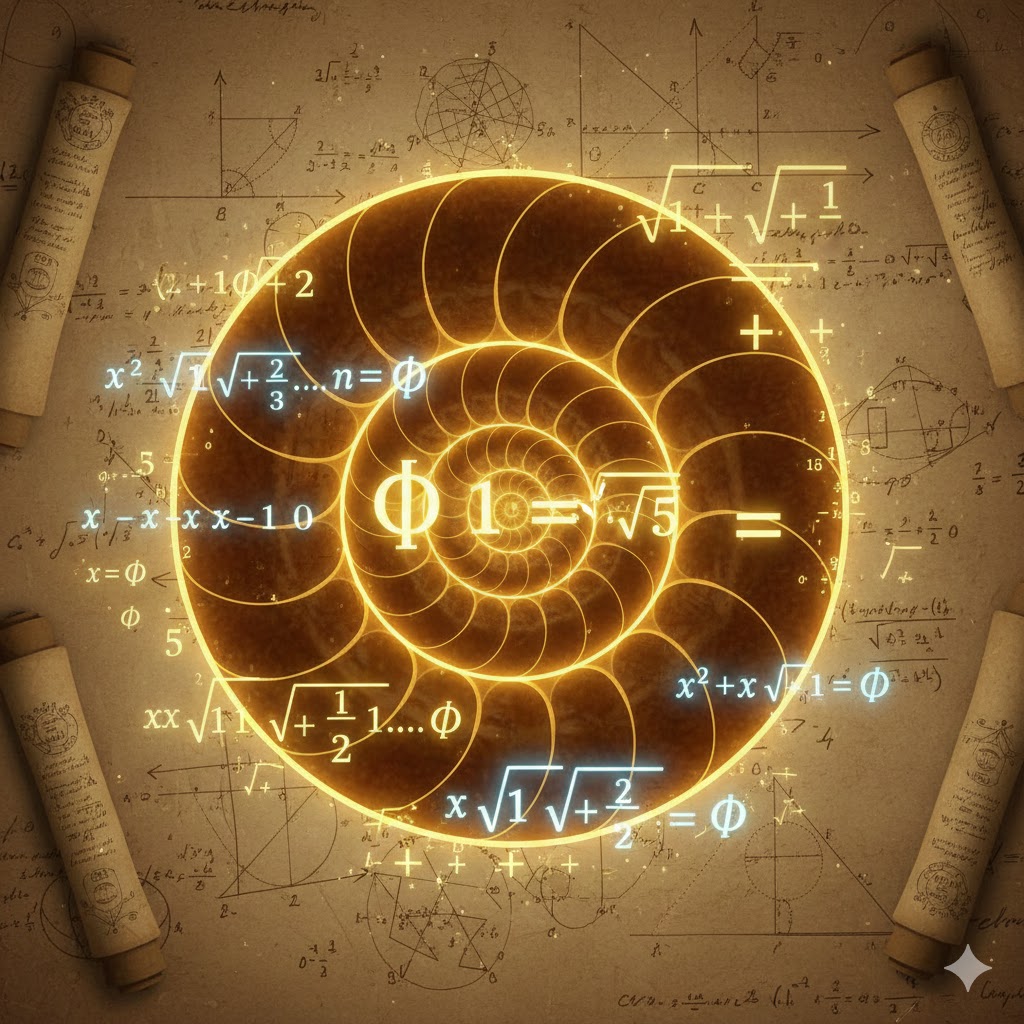 Quadratic irrationals: The mysterious numbers behind infinite patterns.
Exploring the strange world of quadratic irrationals
By Peter Teoh, Science Writer
Quadratic irrationals are irrational numbers that are roots of quadratic equations with integer coefficients. They often appear in number theory, continued fractions, and Diophantine approximation. Below are several example problems involving quadratic irrationals, ranging from basic to more advanced.
Example 1: Identify a Quadratic Irrational
Problem: Show that √2 + √3 is a quadratic irrational.
Solution Sketch: Let x = √2 + √3. Then:
x² = (√2 + √3)² = 2 + 2√6 + 3 = 5 + 2√6
So,
x² − 5 = 2√6 ⟹ (x² − 5)² = 24
x⁴ − 10x² + 25 = 24 ⟹ x⁴ − 10x² + 1 = 0
Thus, x satisfies a degree-4 polynomial—but we can show it’s actually quadratic over a quadratic field. However, note that √2 + √3 is not a quadratic irrational—it’s actually an algebraic number of degree 4!
✅ Correction: A true quadratic irrational must satisfy a quadratic equation with rational (or integer) coefficients. So this example is not a quadratic irrational! Good reminder: not all sums of square roots are quadratic irrationals.
A correct example: Show that (1 + √5)/2 is a quadratic irrational.
Solution: Let x = (1 + √5)/2. Then:
2x = 1 + √5 ⟹ 2x − 1 = √5
Square both sides:
(2x − 1)² = 5 ⟹ 4x² − 4x + 1 = 5 ⟹ 4x² − 4x − 4 = 0
Divide by 4:
x² − x − 1 = 0
So it satisfies a quadratic with integer coefficients → quadratic irrational.
Example 2: Continued Fraction Expansion
Problem: Find the simple continued fraction expansion of √7.
Solution Sketch: Use the standard algorithm for square roots:
- a₀ = floor(√7) = 2
- Set x₀ = √7
- Recursively define: x₍ₙ₊₁₎ = 1/(xₙ − aₙ), and a₍ₙ₊₁₎ = floor(x₍ₙ₊₁₎)
Carrying this out:
- x₀ = √7, a₀ = 2
- x₁ = 1/(√7 − 2) = (√7 + 2)/3, a₁ = 1
- x₂ = 1/((√7+2)/3 − 1) = 3/(√7 − 1) = 3(√7+1)/6 = (√7+1)/2, a₂ = 1
- Continue… eventually you get periodicity.
Answer:
√7 = [2; 1, 1, 1, 4, 1, 1, 1, 4, …] (the part 1, 1, 1, 4 repeats forever)
This illustrates a key fact: the continued fraction of a quadratic irrational is eventually periodic (Lagrange’s theorem).
Example 3: Solve a Pell Equation
Problem: Find the fundamental solution to the Pell equation:
x² − 13y² = 1
Solution Idea: The solutions are related to the continued fraction of √13.
- √13 = [3; 1, 1, 1, 1, 6, 1, 1, 1, 1, 6, …] (period length = 5, odd)
- The fundamental solution comes from the convergent just before the end of the first period.
Compute convergents:
- [3] = 3/1
- [3; 1] = 4/1
- [3; 1, 1] = 7/2
- [3; 1, 1, 1] = 11/3
- [3; 1, 1, 1, 1] = 18/5
- [3; 1, 1, 1, 1, 6] = 119/33
Since period is odd, the minimal solution is from the double period, or check:
18² − 13 × 5² = 324 − 325 = −1 (so this solves x² − 13y² = −1)
Then square it (in the ring ℤ[√13]):
(18 + 5√13)² = 649 + 180√13
Check: 649² − 13 × 180² = 1 ✓
✅ Fundamental solution: (x, y) = (649, 180)
Example 4: Prove a Number is a Quadratic Irrational
Problem: Prove that any real number with an eventually periodic continued fraction is a quadratic irrational.
Approach: This is Lagrange’s Theorem. Sketch:
- Let x = [a₀; a₁, …, aₖ, b₁, b₂, …, bₘ, b₁, b₂, …, bₘ, …] where the b’s repeat
- Let y = [b₁; b₂, …, bₘ, y] (y defined recursively)
- This gives a recursive relation: y = (Ay + B)/(Cy + D) for integers A, B, C, D
- Rearranged: Cy² + (D − A)y − B = 0 → quadratic equation
- So y is a quadratic irrational, and since x is obtained from y by a finite number of linear fractional transformations (with integer coefficients), x is also a quadratic irrational.
Example 5: Conjugate of a Quadratic Irrational
Problem: Let α = (3 + √10)/2. Find its conjugate and compute α + ᾱ and α × ᾱ.
Solution: Conjugate: replace √10 with −√10:
ᾱ = (3 − √10)/2
Then:
α + ᾱ = (3 + √10 + 3 − √10)/2 = 6/2 = 3
α × ᾱ = ((3 + √10)/2) × ((3 − √10)/2) = (9 − 10)/4 = −1/4
So the minimal polynomial is:
x² − 3x − 1/4 = 0, or multiply by 4: 4x² − 12x − 1 = 0
Summary of Key Ideas:
- A quadratic irrational is a real number α not in ℚ such that ax² + bx + c = 0 for integers a, b, c with a ≠ 0.
- They have eventually periodic continued fractions.
- They come in conjugate pairs.
- They are central to solving Pell’s equation x² − Dy² = 1.
Side Notes
- The Golden Ratio φ = (1 + √5)/2 is the most famous quadratic irrational, appearing in art, nature, and architecture.
- Lagrange’s Theorem connects quadratic irrationals to periodic continued fractions — a beautiful bridge between algebra and analysis.
- Pell equations have fascinated mathematicians since ancient India and Greece, with applications in cryptography today.
- Quadratic irrationals are dense on the real line — between any two rational numbers, you can find infinitely many of them!
Trending Sidebar
- Continued Fractions: Explore how infinite fractions can represent irrational numbers.
- The Golden Ratio in Nature: From sunflower seeds to galaxy spirals.
- Pell Equation Solvers: Online tools that compute solutions using continued fractions.
- Algebraic vs Transcendental: Why π and e are fundamentally different from √2.
Leave a comment